

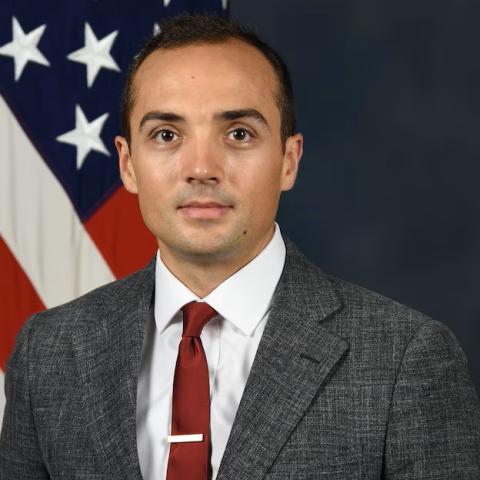










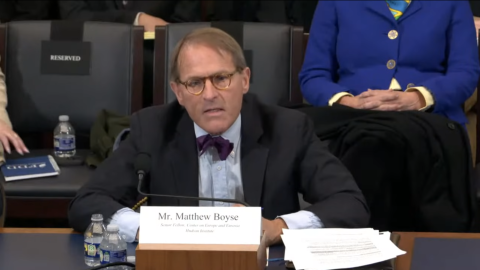
Matt Boyse testified in front of the Foreign Affairs Committee of the United States House of Representatives to examine how weaponized mass migration causes security risks to Europe and the United States.
Written Testimony
View PDF
Chairman Self, Ranking Member Keating, distinguished members of the Committee: thank you for the opportunity to testify before you today.
Before I joined the Hudson Institute, I served in the Foreign Service for 35 years and spent much time dealing with Europe, Central Europe, and NATO Eastern Flank issues, as well as the post-Soviet space. I wrote my first article on weaponized migration as an analyst at Radio Free Europe in 1985. Then it was the East German communist regime trafficking economic migrants from developing countries to West Berlin to earn hard currency and increase social costs and stoke social tensions in West Germany. Since then, we have seen many other cases, including against the United States, such as the Cuban communist regime weaponizing migration during the 1980 Muriel Boatlift and Communist China utilizing “birth tourism” and exploiting other weaknesses in our visa and immigration system. Politicians and policymakers in the United States have long not understood that our adversaries view migrants and mass migration as weapons; the Committee’s attention to this is timely, valuable, and important. This is a complex issue so I have drafted a statement that I would like to submit for the record in order to stay within my five minutes.
Some may ask why Americans should care about this phenomenon in the first place. Don’t we have enough migration-related problems at home? Isn’t migration a global phenomenon, driven by poverty, conflict, war, poor governance, etc.? Aren’t EU treaties and regulations “pull factors” responsible for enabling migrants to claim asylum easily and abuse the generosity of humanitarian-minded European taxpayers? Isn’t using migration just another “tool in the toolbox” or “instrument” of statecraft that some states use to pursue their foreign policy goals? Doesn’t the term “weaponized” itself sound unnecessarily “martial”? Doesn’t organized crime traffic in migrants? Isn’t migration necessary to bolster demographic decline? Don’t migrants enrich our societies? And where is the evidence that any particular state is behind these problems, in this case Russia, the state most widely linked to them?
Critics of the weaponization thesis make these arguments, and some are worth discussing, but I will argue that: 1) the men who rule Russia today view and use migration as a weapon; 2) the Kremlin has been a “push factor,” playing a role in, magnifying or driving recent migration crises in Europe or that affect Europe; and 3) there is no way to avoid the conclusion that the Kremlin is weaponizing migration if we apply the “cui bono” (“who benefits?”) standard. Other communist regimes and dictatorships learned this tool from the USSR and Russia, and also weaponize migrants. I will further argue that this matters to the United States because of the negative effects it has on our NATO Allies, and thus the U.S. national interest. Strong and capable allies are a vital U.S. interest, and mass migration -- weaponized against the NATO space -- makes them, and us, weaker.
In weaponizing migrants, Putin has drawn on the Soviet playbook of using ethnic groups as pawns to achieve larger political goals – we need recall only a few cases such as the treatment of Crimean Tatars and ethnic Germans. Putin has updated the Soviet concept of “active measures” – the basket of non-kinetic tools, often carried out by the KGB and GRU, that bring pressure to bear on adversaries and weaken them – into the well-known broader concept of “hybrid war,” which uses migrants as “human ammunition” (as one expert calls it), alongside disinformation, misinformation, cyber and other attacks on infrastructure, assassination, subversion, sabotage and much more to generate leverage in the pursuit of foreign policy goals, to punish and to undermine NATO and its member states, to interfere in their domestic affairs and to divide them, to use demographic and civilizational issues against the West, and to exacerbate transatlantic differences – all to the detriment of U.S. interests. The migration weapon increases Allies’ security vulnerabilities and thus weakens our own security. It is great that Congress is paying attention to this.
There is thus continuity and a direct relationship between the Soviet and Putin eras in the use of migration as a weapon, even as the ways, means, and goals of deploying it have evolved. Putin is applying similar weapons as did his Soviet predecessors and other communist leaders elsewhere. This should surprise no one given his KGB background, the large number of people at the top of his regime from the intelligence services, and the vast role they play in the Russian state and Kremlin statecraft. As the saying goes, “Once a Chekist, always a Chekist.”
There has been much excellent reporting and analysis of Putin’s use of migration as a weapon, but the phenomenon is more complex and widespread than Northeast and Northern Europe - Poland, the Baltics and the Nordics (especially Finland and Norway), where it has been most visible. Russia has also been targeting NATO’s Southern and Southeastern Flank (the Mediterranean and Turkey) via the Middle East, as well as Africa where Russian malign activity has destabilized the Magreb, Sahel, and parts of Sub-Saharan Africa, sending almost five million people toward Europe from these regions in the last 10-12 years. Of course, Germany remains a primary Putin target.
Strategic Backdrop: Russians in their Own Words
When Russian officials openly talk about migration as a foreign policy weapon, we should listen. The influential ideologue and strategist Alexander Dugin articulated the Kremlin mindset in 1997 when he wrote: “those who are quicker to develop a model for the disintegration and chaoticization (sic) of societies other than their own will be the winners in the complex game of construction of new international relations, new societies and a new philosophy of life. Chaos is a multipurpose weapon.” Former Putin advisor Vladislav Surkov pushed a strategy of “projecting chaos” and creating divisions by non-military means to achieve geopolitical objectives in neighboring states or politico-military alliances. In his General Theory of War, “maskirovka” champion Maj. Gen. Alexander Vladimirov wrote about using migration in a coercive manner by creating the conditions for the flow and settlement of small, active minorities or ethnic groups on the territory of a hostile state that would prepare a beachhead to enable larger waves of migrants to destabilize enemy territory. By creating conditions in home countries that make stability impossible, the flows of migrants can be increased. He also stressed the importance of exploiting cultural and psychological factors like the basic humanity of European societies to achieving victory in the current asymmetric war. Soviet defector and former KGB officer Maj. Gen. Oleg Kalugin once told CNN how active measures like these “prepare the ground in case war actually broke out.”
In 2023, Russian officials told senior Finnish officials that they are using migration as a weapon, commenting that we “have a tool here that works against you.” And in 2023, former FSB Director and Security Council Secretary Nikolai Patrushev travelled to Cuba and Latin America and spoke approvingly of our southern neighbors regaining control of territory in the Southwestern United States allegedly stolen from Mexico, describing the United States as “a patchwork quilt that can easily come apart at the seams.” None of these views are new but they bear repeating given lingering skepticism in some quarters that migration is being weaponized.
Evidence of the Russian regime’s role in weaponizing migration comes in many forms. In all the major migration crises Europe has faced in the last decade or so, the Kremlin, allied communist regimes, or other proxies have played a role in the movement of people to the continent. Whether it was the 2015 bombing campaign in Syria that displaced hundreds of thousands of people and drove them to Turkey, from where they made their way to Europe, or the trafficking of migrants to the Finnish and Norwegian borders, or the support for Belarusian proxy Alexander Lukashenko who sent thousands to the borders of Poland, Lithuania and Latvia -- in case after case Russia has acted as either an instigator, promoter, facilitator, or ally. There is no way for migrants to get to Russia’s border with Finland or Norway without Russian visas and the active participation of the FSB and the Border Service, which controls access to those regions. The Director of the Border Service is a Deputy Director of the FSB and carries out his orders.
Organized crime groups have played roles in some of these crises to obscure the role of the Kremlin, which has a long history of using them as instruments of statecraft. Migrants are like a thermostat that can be dialed up or down, putting NATO member states under pressure when and as desired to send short term political messages, exact costs, seek policy changes, and over the long run to accelerate weaknesses in Western societies from within.
Case Studies
Migration scholars have looked at many weaponized migration crises in the last several decades, some major and others less so. Time and space constraints allow me to cover only a few of the most visible cases.
Russia/Ukraine: Russia’s war against Ukraine has been the largest and most dramatic case of weaponized migration. For almost 12 years, the Kremlin’s explicit and relentless attacks on civilians and civilian infrastructure leave no possible other explanation than that Putin has been using migration to terrorize civilians, displace them, and force them to leave their country. What began with the displacement of 2-3 million Ukrainians from occupied Crimea and Eastern Ukraine in 2014 has now reached some 5-6 million who have found refuge outside the country and some 3.7 million more are internally displaced -- the largest forced migration in Europe since World War II, 75-90% of whom are women and children. The Kremlin has used tested Soviet concepts of filtration camps and ethnic cleansing in areas it occupies. The Kremlin mindset expects that Ukrainians who have found safety outside the country will eventually be seen as burdens as host country governments grow tired of supporting them financially and citizens resent the competition for medical care, education, and housing. The longer it continues its war, the more negative Moscow sees the consequences for its victims.
Russia/Syria/Turkey/Greece/Eastern Med: The 2015 Syrian crisis has also had outsize influence on Europe. The September Russian bombing campaign in support of Assad focused primarily on cities and opposition areas and only minimally on military targets. This leaves no other conclusion than that Moscow was intentionally targeting civilian populations. The result forced an exodus of more than six million refugees into neighboring countries, more than one million of whom moved to Europe. When Turkey in November of that year downed a Russian SU-24 fighter aircraft that entered its airspace, one of Russia’s responses was to bomb additional Syrian civilian areas, increasing refugee flows into Turkey, which prompted PM Erdogan to accuse Russia of engaging in state terrorism. These flows put further pressure on Turkey and led to an Erdogan apology seven months later. For its part, Ankara did not let the opportunity pass to use Syrian refugees in Turkey as leverage for its own foreign policy when Erdogan threatened to “open the gates” to flood Europe. This secured a major package in the form of the EU-Turkey Statement in March 2016, which included some six billion euros in financial benefits, visa-free travel for Turkish citizens, and EU accession talks.
Russia/Norway/Finland: The border regime between Russia and Norway and Russia and Finland worked relatively from the 1950s until Fall 2015, when Russia began to allow third-country nationals in large numbers to cross the border with Norway without proper visas, and from December 2015 into Finland. Given the timing and lack of other plausible explanations, the cause was likely retaliation for EU sanctions against Russia for its illegal occupation of Crimea and Eastern Ukraine and the downing of MH-17. In the Finnish case, it was likely also a warning against any move towards NATO membership. Migrants’ countries of origin -- Iraq, Afghanistan, Somalia, South Asia, Syria, Libya, and elsewhere -- fit the pattern of Russian-inspired weaponized migration. Most obtained tourist or student visas in Damascus, Iraq, or Beirut, flew to Moscow, and traveled by train and bus to the Norwegian or Finnish borders where they biked or walked to border crossings to claim asylum. Some purchased “package deals” from businesspeople or murky groups. Both Norway and Finland sought to send them back into Russia, but Moscow refused to accept them back. In January-February 2016 alone, about 1,000 migrants and asylum seekers crossed the Finnish–Russian border, compared to only 700 in 2015. Finnish and Norwegian sources estimate the total number of Russian-trafficked migrants during 2015-16 at about 7,200.
None of these large movements of people could have happened without the approval of the Russian regime. Murmansk is a high security region with a large concentration of military assets. Russia requires special permits to enter the border zone, which is controlled by the FSB, Federal Border Service, and local police. Regional authorities assisted with transport to open crossing points and even fed and housed the travelers. Regional FSB officials could not have acted in such a way without top cover from the Security Council or Presidential Administration. Organized crime groups were also involved.
There was another crisis on the Russia-Finland border in 2023, when Finland again tightened its visa policies vis a vis Russians. In response, the Kremlin instigated another wave of migrants from Syria, Iraq, Yemen, Somalia, Ethiopia, and Egypt. The modus operandi was similar to the other crises in logistics and modalities, but Finnish authorities asserted that this time Russia was escalating, for example by looking the other way on travel documents and assisting migrants more actively to get there. This time, however, Russia’s behavior increased Finnish sentiment critical of migrants, society became much more united, and voters demanded tough responses from the government.
Russia/North Africa/Southern Mediterranean: For years Russia has been involved in African conflicts -- in the Magreb, Sahel, and Sub-Saharan Africa, especially Libya, Sudan, Mali, Burkina Faso, Niger, and the Central African Republic (CAR). Its vehicle for much of this time was the Wagner Group of mercenaries under Yevgeny Prigozhin (until his death). Its vehicle now is via the rebranded Africa Corps, which operates under the control of the Russian Defense Ministry. Each conflict is different but there are similarities. Among Russia’s many goals have been: weakening French influence in these regions and generating flows of migrants. Russia has achieved both goals, as French influence is less than ever before and hundreds of thousands of residents of these regions have sought and obtained asylum in Europe. These Russian activities have placed major pressure on NATO member states in Southern Europe.
In the Magreb, Russia has opened a new front against the West in Libya. Moscow’s support for the warlord General Haftar since about 2016 has contributed to pushing hundreds of thousands of Libyans into flight, often towards Europe, particularly Italy, traditionally its main focus. For years, Italian governments have accused Russian mercenaries of engaging with human trafficking gangs in eastern Libya to direct migrants to embarkation points or to centers whence they organize departures by sea toward Italy.
Russian mercenaries have secured vast territory in southern and eastern Libya, where they control key transit routes used by sub-Saharan migrants and can "open or close the tap" on migration flows while using them as political levers. This recalls Gaddafi’s use during the 2000s of Libya’s strategic location on migrant transit routes to threaten Europe with “turning into Africa.” This succeeded in extracting major financial and political benefits from the EU, and especially Italy, between 2004 and his death in 2011. Frontex warned in its 2024/2025 report that Russia’s consolidation of power in Libya, and the Sahel more broadly, allows it to "create and possibly direct migratory flows" for years to come.
In the Sahel, Wagner mercenaries have contributed to, if not triggered, mass movements of people through atrocities and violence in Mali and CAR. Experts have documented systemic human rights abuses, including extrajudicial killings and village burnings, which force thousands of civilians to flee toward Europe via North African routes. By supporting military juntas and failing to contain jihadist insurgencies, these forces have created a climate of insecurity that makes it difficult for residents in the region to remain there over the long run.
Morocco/Spain: Russia does not, however, influence or control all weaponized migration in the Magreb. Morocco has been using migrants to change Spanish policy, and it has succeeded. The most dramatic changes occurred after Morocco in 2021 pushed 8,000-10,000 people into the Spanish enclaves of Ceuta and Melilla in just two days after Spain offered hospital treatment to a rebel leader from the Western Sahara, an area Spain then did not recognize as under Moroccan sovereignty. Since then, Spain abandoned nearly 50 years of neutrality on the Western Sahara conflict and PM Sanchez endorsed Morocco’s 2007 autonomy plan for the region as the “most serious, realistic, and credible.”
Belarus/Poland: Warsaw began to see major weaponized migration on its borders after the EU imposed sanctions on Belarus in 2021 for the fraudulent August 2020 elections. Russia strongly supported Belarus dictator Lukashenka, assuring him of assistance against external pressure within the framework of the Collective Security Treaty Organization. The EU ramped up sanctions further after Belarus forced Ryanair flight 4978 to land in Minsk in May 2021, allegedly because of a bomb threat that was bogus. Beginning in June 2021, illegal border crossings increased dramatically. Air traffic to Minsk from the Middle East more than doubled, including a daily flight from Syria and Iraq, where the regime opened travel offices in several cities, offering package deals via state tourist agencies, complete with hotels and visas, and facilitated by men in unmarked uniforms. There were also flights from Libya, Turkiye, Armenia, Uzbekistan, and Iran. These channels funneled tens of thousands of migrants to the Polish border. Belarus also offered visas upon arrival in Minsk. In response, the Polish government radically increased its border security but estimated that as many as 30,000 people still attempted illegal crossings per year during the height of the crisis. Migrants often responded with violence, in one case killing a Polish border officer. The regime demonstrated its complicity by supplying lasers and bright lights to blind Polish border personnel.
By December 2025, migrants were digging tunnels under the border with support from Belarusians. Polish Interior Minister Kierwiński has blamed the regime for enabling this activity and authorities estimated that about 180 people travelled used the tunnel, 130 of whom were arrested in Poland. Polish authorities see clear Russian involvement, with as many as 90% of detainees in some months having Russian visas and travelling from Moscow via Minsk. Polish FM Sikorski has referred to these as “attempts to destroy the EU from the inside” while Belarusian opposition leader in exile Sviatlana Tsikhnaouskaya calls them attempts by the Lukashenka regime “to blackmail the EU and scare it with waves of uncontrollable migrants.” The migrants’ countries of origin were similar as in the other crises -- mainly the Middle East, Asia and Africa, but with greater South Asian representation. Belarus was also aided in its efforts by the fact that it does not abide by the European Convention of Human Rights, of which it is not a member.
Belarus/Lithuania/Latvia: Lithuania and Latvia were the targets of similar weaponized migration instigated by the Belarus regime for the same reasons as was Poland, albeit in lower numbers. The motivation was similar as the regime facilitated the arrival of thousands of migrants, primarily from the Middle East (Iraq, Syria, Afghanistan) and Africa, by air to Minsk on special visas. The Belarusian security services and state travel agencies were directly involved in transporting migrants to the EU border and sometimes forcing them to cross illegally. Lithuania and Latvia responded similarly as Poland did, building border defenses but also filing a case against Belarus at the International Court of Justice and seeking to hold the regime legally accountable for human trafficking and violating international law. Lithuania experienced a massive surge of over 8,100 border crossing attempts in 2021, but numbers fell to 1,002 in 2024. However, 2025 saw a resurgence with 1,608 attempts recorded. Latvia also experienced increased pressure in recent years. In 2021, during the first peak of the state-orchestrated migration crisis, Latvia recorded 4,000-4,500 attempts to cross its border illegally from Belarus. In 2025, it recorded over 12,000 attempts, a significant increase from 5,306 in 2024. Many of these were “push backs” but the scale is significant for countries with fewer resources.
European Union/Member States: The European Commission is a separate case as it does not involve Russia, but Brussels has used the migration and asylum issues to discipline some member states for refusing to accept mandatory distributions of migrants. During and after the 2015 crisis, conservative Polish and Hungarian governments resisted compulsory resettlement quotas on the grounds that they did not wish to import and support thousands of often single, military age males and others with values and customs very different from their own. EC officials and EU politicians publicly criticized these countries and used their refusal as grounds to deny EU funds to which they were entitled. In June 2024, the European Court of Justice fined Hungary €200 million, plus a €1 million daily penalty, for violating EU asylum laws and failing to comply with a 2020 ruling regarding the treatment of migrants. Due to non-payment, the EU began deducting these fines from budget funds, with penalties exceeding €500 million by April 2025. As of late 2025, Poland had not been fined for refusing to accept migrants under the EU Pact on Migration and Asylum, despite rejecting its mandatory solidarity mechanism. Poland was granted exemptions from both accepting migrants and paying the required €20,000-per-person fee due to the massive pressure of hosting hundreds of thousands of Ukrainian refugees and facing weaponized migration on its border with Belarus.
Why Does Weaponized Migration Matter to the United States?
While there are positive effects of legal migration, mass and weaponized migration also weakens NATO member states, and thus U.S. interests. It adds to large existing migrant communities where identification with and support for the values of the host country and the West are already soft. These populations already display a higher incidence of crime, violence, rape, stabbings, integration problems, parallel societies, social conflict, poverty, unemployment, fraud, and other pathologies than the host societies, which introduces further strains into their societies. It imposes huge financial costs to national budgets, burdens social services, swamps government capacity, increases domestic tensions, and polarizes politics – all without confronting NATO or its member states militarily. Students of Russian and Soviet history will immediately recognize the Soviet principle, often attributed to Lenin, relevant here: Чемхуже, темлучше” or “the worse (the situation is for the adversary), the better (it is for us).”
The Kremlin considers weaponized migration as especially effective against democracies, which tend to have humane, generous, approaches to people who claim to be refugees or asylum seekers, strong legal structures to support them, and elites who back them -- and who do not always strongly defend their own cultures. The idea that mass migration is a human right or moral necessity is also common in Europe. These conditions make weaponization easier. A study by the German Council on Foreign Relations concluded that the Kremlin has the longer-term goal of using weaponized migration to weaken NATO member states. And refugee crises offer plausible deniability, as Moscow can respond: “What us? Prove it!”
Nexus with Islamism: Weaponized migration has also fed the growth and spread of Islamist groups and ideology that exacerbate societal tensions and undermine Allies’ reliability in confronting challenges facing the Global West. NATO member states remain not only targets of terrorism – as Taylor Swift’s cancelled concerts in August 2025 in Vienna demonstrated – but also breeding grounds, bases of operation, and launchpads for global Islamist networks. This nexus has altered political dynamics across the alliance; every NATO member state now has at least one party with a strong focus on migration, Islam, and Islamism, which in almost a dozen countries is either among the most popular, can influence policy, decide governing coalitions, holds power or is a candidate for power. While this focus is positive, many of these parties are also accommodationist or explicitly pro-Putin, not strongly supportive of NATO, contain varying degrees of anti-Americanism, and/or oppose key U.S. foreign policy priorities in Europe.
This nexus has, for example, increased differences with the USG over Middle East policy, especially on Israel, as European governments prioritize pro-Palestinian sentiment and winning elections. The USG has had difficulty generating support for designating the IRGC, Hamas, Lebanese Hizballah, and Muslim Brotherhood as terrorist organizations, in large part because of large Muslim and Arab voting blocks. Over the years, the nexus has contributed to softer Iran policies, enabling Tehran to expand its malign influence across the Middle East, as well as to surges in domestic antisemitism and hostile environments for Jews. Islamist networks based in Europe and elsewhere fan the flames of antisemitism, weaponizing it against Allies and partners, and weakening U.S. interests and positions. After Labor benefitted from large voting blocks in the 2024 UK elections, PM Starmer dropped longstanding policy and recognized Palestine and his government refuses to confront visible and growing manifestations of Islamism. French PM Macron has behaved in a similar manner.
It is not for the United States to get deeply involved in Europe’s weaponized migration or its Islamism problem. The landscape varies between countries that have been relatively effective (Denmark) and those that have not (UK, France, Belgium, and Germany). However, NATO member state leaders are not winning the struggle against these problems and need to adopt more robust responses.
Conclusion
The United States has allies in European law enforcement and intelligence agencies, and in politics, government, and think tanks who agree that weaponized migration negatively affects the security of the NATO space and who are doing what they can to deal with it. Some have warned of these phenomena for years, others have only recognized them more recently, while others do not have top-cover as their leaders do not see weaponized migration as a problem.
All NATO member states to varying degrees have taken steps against the more common aspects of Russian hybrid war, but responses to weaponized migration have generally been insufficient and show no signs of deterring Russia from continuing the practice. Frontline countries like Poland, Hungary, Finland, and the Baltic states have built major border infrastructure complete with fences, walls, high tech sensors, and large border forces to defend themselves. They have also closed border crossings, tightened visa policies and asylum decisions, and argued for more robust border measures at the EU level. Frontex has received much larger budgets to beef up border control assets on the EU periphery. Since the 2015 migration crisis, the European Commission has transferred billions of euros to incentivize (some say “bribe”) transit states like Turkey, Morocco, Libya, and Tunisia to keep migrants away. However, some NATO member states remain in denial; Spain recently began to legalize some 500,000 recent migrants. Those states that understand the problem and are taking steps to deal with it are halfway there, but more must be done.
Potential actions such as returning to their countries persons convicted of crimes, whose asylum applications have been denied, or who have become radicalized seem a bridge too far for most NATO member states. Some political parties depend on the votes of migrant communities or supporters of mass migration to win elections or to stay in power. Migrants who have managed to make it to Europe enjoy strong legal protections. And so, these large populations serve as domestic stressors and thus weaken allies, to the detriment of U.S. interests. Allies that do not take appropriate steps are not helping to address long-term challenges to the alliance.
Some may argue that the United States does not have a dog in this fight, that these are European problems, or that the EU has contributed to or exacerbated them by not responding robustly. But the status quo is not working, and the United States cannot do nothing. These phenomena are not just “irregular migration flows.” They are intentional, strategic, and brazen as they weaponize people as pawns in the Kremlin’s ongoing grand geopolitical project.
I recommend the Committee consider several options to address the challenges set forth in its invitation.
Diplomatic
- Strongly support those NATO member states that have taken robust steps to defend themselves against weaponized and mass migration. That includes support for more resolute measures. Allies/friends/partners that are doing the right things deserve U.S. solidarity.
- Resist pressure from groups that criticize or legally challenge NATO member state governments for taking strong steps to safeguard their borders and deal effectively with weaponized and mass migration.
- Take Russia to task in the UN system and at other international fora, especially those that deal with migration, refugees, asylum, and human rights – e.g. IOM, OSCE, Helsinki Commission, UNHCR -- for weaponizing people. It is unacceptable in the 21st century for Russia and other dictatorships to use people as pawns in their grand foreign policy and geopolitical designs.
- Engage NATO member states in a frank dialogue about the negative consequences of weaponized and mass migration and urge them to act in a more decisive manner. Some may resist on the grounds that such dialogue “interferes in their internal affairs” or would violate international conventions and humanitarian law. Given U.S. security commitments to Europe, however, the United States expects robust action. Refusal to act on U.S. concerns undermines U.S. interests.
- Signal that the United States cares about this issue. If necessary, issue public statements, even if they generate backlash. After all, European politicians are not shy about commenting on domestic U.S. migration issues. While a few prominent Europeans – e.g. Italian PM Georgia Meloni and Germany’s Axel Springer CEO Matthias Doepfner – have publicly stated that Vice President JD Vance’s comments at the 2025 Munich Security Conference were valid, they were a small minority. However, polite dialogue does not always work, and more blunt messaging may be necessary.
- Engage the EU and relevant international organizations to examine laws, policies, and conventions on asylum and refugees for ways the United States and the EU can collaborate on adjusting them to current realities. For example, the traditional standard of “well-founded fear of persecution” as set forth in the 1951 Geneva Convention and the role of transit countries needs attention, as does the practice of “defensive asylum” within the Common European Asylum System.
Law Enforcement
- Ensure that U.S. engagement with Frontex and other European law enforcement agencies that deal with migration is close and collaborative.
- Ensure that the State Department and law enforcement agencies are engaging with the Center of Excellence on Hybrid Threats in Helsinki, and that it focuses on weaponized migration.
- Allocate resources to ensure that U.S.-EU law enforcement collaboration on migration issues is funded.
Thank you again for the opportunity to speak with you today. I look forward to your questions. Matt Boyse testifies in front of Foreign Affairs Committee