












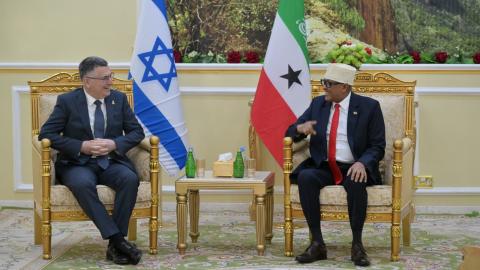
Somaliland, a small territory on the Gulf of Aden, has long sought independence yet received little international attention. But on December 26, 2025, Israel announced its official recognition of the enclave as a sovereign state.
Israel’s announcement went largely unnoticed—until it met a wave of international condemnations. Despite this pushback, Jerusalem’s recognition of Somaliland could transform the Red Sea and Horn of Africa’s geopolitical balance and global trade flows.
Israel’s decision is neither hasty nor provocative. It is historically, legally, and strategically coherent. Further, Western nations’ hesitancy to follow suit reveals contradictions between their stated moral and strategic aims and their actions.
Context
Somaliland is not an opportunistic, secessionist entity, as some suggest. It has a distinct historical trajectory that predates the collapse of Somalia. The Somali people did not draw the borders of Somalia, but instead European powers merged distinct colonial jurisdictions and political-clan systems under a single state framework, despite the absence of a shared institutional or constitutional foundation. Today’s Somaliland was a protectorate of the United Kingdom (British Somaliland), while Italy held the other Somali territory until World War II. After gaining independence in June 1960, Somaliland voluntarily chose to unite with the Somali territory under United Nations and Italian administration. Therefore, Somaliland has existed longer as a separate entity than as part of the subsequent union. The territory’s authorities also never properly formalized the union—which was poorly formalized in legal terms—and later Mogadishu unilaterally created the consolidated country, leaving it fundamentally defective under international law. The union ended three decades later in manifest failure. In 1991, following the collapse of the Somali state, Somaliland reclaimed its independence.
Since then, Somaliland has stood in stark contrast to its larger, internationally recognized neighbor. Despite massive institutional and financial support from the UN and other bodies, Somalia has suffered chronic instability—civil war, endemic corruption, piracy, and the entrenched presence of Islamist groups such as al-Shabaab. Somaliland has followed the opposite path. With little international aid, it rebuilt itself through endogenous mechanisms: clan conferences, local political compromises, and the gradual consolidation of institutions. The result is a largely controlled territory, though there are localized and intermittent challenges in its eastern regions. Still, its government has regular elections, peaceful transfers of power, a currency, security forces, and a functioning state apparatus. Somaliland therefore appears to be a durable, successful state in all but official title.
Israel-Somaliland relations date back to even before the 1991 collapse. In the late 1980s, Israel alerted international bodies, including the UN, about the Siad Barre regime’s massive, systemic repression and abuse of the Isaaq people, who comprise most of Somaliland’s population. But these warnings were largely ignored. For the last two decades, Israel and Israeli nongovernmental organizations have provided medical aid to Somaliland, a vital diplomatic and humanitarian effort.
Strategic Importance
Israel’s recognition of Somaliland is not just a matter of history or morality. It is above all a strategic decision that reshapes the regional balance of power. The enclave sits along the Gulf of Aden near the entrance to the Bab el-Mandeb Strait, a vital passage linking the Indian Ocean to the Red Sea, Suez Canal, and Mediterranean Sea. Stability in this corridor affects a major share of global trade. The Iran-backed Houthis’ strikes against maritime traffic in the area underscored both the passageway’s vulnerability and its importance. The United States’ primary objective for intervening against these strikes was not to defend Israel, but to prevent the Houthis from paralyzing international commerce.
In this context, Somaliland is a major strategic asset. It controls the deep-water port of Berbera, which investments by the United Arab Emirates have modernized. This port could, in time, become an essential foothold for Western-aligned powers in the Horn of Africa, enabling them to counterbalance Iran’s influence in Yemen and Qatar’s ideological activism.
Israel has therefore taken a major step toward securing a contested, strategic gateway to one of the planet’s most sensitive chokepoints. This gives Jerusalem a critical geopolitical vantage that enhances its situational awareness and strategic depth vis-à-vis the Red Sea corridor as the Houthis, who have declared war on Israel, continue to target Israeli cities and maritime traffic. Israel has accomplished this without any ambition of establishing a military base. This decision also fits Israel’s broader strategy to counterbalance Turkish expansionism. To that end, Jerusalem has recently worked to strengthen its alliances with the Eastern Mediterranean states of Greece and Cyprus.
Why the US and Its European Allies Should Recognize Somaliland
Ultimately, Somaliland is everything the US and its North Atlantic Treaty Organization allies claim to seek in a regional partner: a stable, democratic, and pro-Western government that is opposed to political Islam and is in a strategically important location. To deny the enclave recognition in the name of selectively applied principles is to privilege diplomatic fiction over geopolitical reality. The clear benefits of expanding ties to Somaliland, and the relative absence of counterarguments, accentuate the strategic incoherence of many NATO states. Several European countries have espoused support for the recognition of a Palestinian state despite Palestine’s failure to meet even the minimum criteria of the Montevideo Convention on the Rights and Duties of States (1933).1 Refusing to even consider recognition for Somaliland, which has met these criteria for more than 30 years makes international law an arbitrary instrument that policymakers invoke when it serves their purposes and ignore when it contradicts them.
However, recognizing Somaliland comes with significant political risks and cost-benefit questions that extend well beyond the territory itself. Such a move could undermine the international norm of territorial integrity upheld by the African Union and weaken international law–based arguments against unilateral secessions. But the African Union position on the topic is not monolithic, and incremental recognition by a few key states would normalize the issue over time. A similar situation occurred in Kosovo and South Sudan.
One should also not ignore the security risks of Somalia reacting violently to this recognition. After all, jihadist groups and other malign actors could exploit this diplomatic turbulence. Establishing ties with Somaliland may also complicate US and European efforts to increase cooperation with Turkey.
But many of these dynamics are already unfolding, and dire predictions of systemic collapse often overestimate second-order effects—as illustrated by earlier forecasts of regional war following the killing of Qassem Soleimani or the relocation of the US embassy to Jerusalem, neither of which produced a crisis.
Moreover, networks linked to Iran and to the Muslim Brotherhood—notably those supported and financed by Qatar—are escalating their destabilization operations in Europe. Recognizing Somaliland could be part of a broader and more coherent European strategic posture against this interference. Ties with Somaliland would help construct a robust anti-Islamist coalition anchored both on the Continent and along key strategic corridors, sending a powerful political signal. Such a move would demonstrate the West’s renewed willingness to confront this threat directly, not only through rhetoric or defensive measures, but also through concrete geopolitical moves that reshape alliances, secure critical regions, and reassert strategic initiative. Washington has also historically preferred strategic ambiguity while deepening its informal engagement with certain partners, which Somaliland could become. Furthermore, recognition could help the US diversify basing options (it already operates Camp Lemonnier in Djibouti), reduce its dependence on a single host country, provide a more reliable counterterrorism partner against al-Shabaab, and maintain a way to shape the Red Sea’s security architecture.
The question, therefore, is not whether recognition of Somaliland is legitimate, but how much longer Western nations will look the other way at the cost of their strategic credibility.