
















China’s Arctic ambition is no longer a curiosity. It is a disciplined campaign — economic, scientific, diplomatic and informational — aimed at building durable leverage in a region that matters to U.S. homeland defense and NATO’s ability to reinforce Europe.
The question for Washington is not whether China will become an Arctic power (Beijing has already decided it will), but whether the United States and its allies will deny China the quiet “dual-use” footholds that have become a hallmark of the CCP’s global playbook.
Start with Beijing’s own words. In January 2018, China released its first official Arctic white paper and introduced one of the most audacious branding moves in modern geopolitics: describing itself as a “near-Arctic state.” The label is not a geographic fact; it is a political claim, an argument that China’s interests justify participation in governance and privileged access to resources far from its shores.
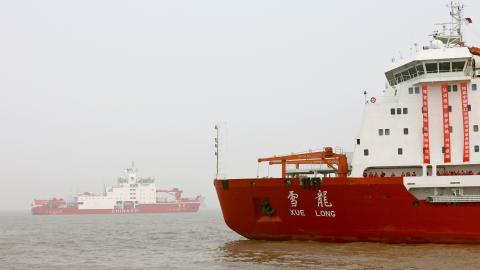
The goal for China, roughly 900 miles south of the Arctic Circle, is to become a “polar great power” by 2030. The purpose is familiar: Normalize Chinese presence now so influence and control feel inevitable later.
Russia, unlike China, is a legitimate Arctic nation with vast territory above the Arctic Circle and long-standing military activity in the High North. The danger today is not Russia’s geography but the accelerating Russia-China rapprochement that has begun to pull China — an unmistakably non-Arctic power and the primary enabler of global conflicts in Ukraine, Tehran, the Gaza Strip and Caracas — into the region’s strategic bloodstream.
In a crisis, the Arctic is not merely about ships and ports; it is about trajectories. Polar routes are the most direct pathways for long-range strike systems, and Greenland sits near the seam connecting Eurasian launch corridors to North American targets. As adversaries coordinate, the threat envelope expands.
It becomes easier to imagine Chinese strategic capabilities benefiting from Russian depth and then transiting the Arctic approaches, including over or near Greenland, toward Boston, New York and Washington, compressing warning time and complicating interception.
This is not abstract theorizing. It is visible in a pattern of attempted entry points across the Arctic region, marketed as benign commerce or science but with credible dual-use potential. Consider Iceland. In 2011, Chinese businessman Huang Nubo sought to purchase a massive tract of land, about 115 square miles, in northeastern Iceland at Grimsstaoir a Fjollum, a deal Iceland ultimately rejected under its laws restricting large-scale land purchases by non-European Economic Area nationals.
The episode mattered less for what it achieved than for what it revealed: Beijing-linked actors were probing for physical real estate in strategically located, lightly populated terrain. It’s exactly the sort of access that can later support logistics and communications or influence operations under a civilian cover story.
Even where land purchases fail, the PRC’s “research” footprint advances. China’s polar science is often presented as climate-minded and cooperative. Yet Arctic research can be dual-use: useful for navigation, communications resilience, surveillance and operational planning.
A U.S. House select committee document points specifically to the China-Iceland Arctic Observatory at Karholl, warning that it “appears to perform dual-use research” on the territory of a NATO ally. News reporting on the same facility notes it has drawn scrutiny in Washington for potential military relevance. Scholars such as Anne-Marie Brady have likewise long argued that Beijing treats polar research as part of a comprehensive state strategy, i.e., blending science with power projection and influence operations.
This dual-use logic matters because China, unlike Russia, possesses the economic and technological depth to operationalize Arctic dominance at scale. Russia can deploy forces and disrupt. China can finance infrastructure, shape supply chains, saturate weak-governance environments with investment, and capture strategic sectors such as telecom, satellites, logistics, minerals and data.
By gross domestic product, China’s economy is roughly 10 times bigger than Russia’s. That gap is the difference between episodic disruption and systemic control. It is also why the West faces an asymmetric problem: Many authoritarian outliers are sanctioned out of the global marketplace, yet China, the most capable revisionist power, continues to benefit enormously from full engagement with the international free market system, subsidizing the very capacities it uses for strategic expansion and the ultimate demise of the West.
Greenland sits at the center of this contest. It is keystone terrain for North Atlantic and Arctic security and hosts the U.S. northernmost installation, Pituffik Space Base, a major node for missile warning, missile defense, and space surveillance for the U.S. and NATO. As the Arctic becomes more operationally relevant, Greenland’s value grows.
Geography makes this personal. New York City is dramatically closer to Greenland than Copenhagen is. Greenland is not Denmark’s backyard; it is America’s northern high ground. Even Greenland’s connectivity reflects its strategic dilemma. Although travel and commerce have traditionally routed through Copenhagen, the island’s security relevance points west toward North America.
A serious U.S. homeland defense posture must treat Greenland less as a distant European administrative matter and more as the forward edge of the defense of the American East Coast, increasingly vulnerable to China’s fast-developing long-range DF nuclear missiles.
History also matters. Denmark has repeatedly shown a willingness to restructure or divest overseas holdings for strategic and financial reasons. It sold Danish India (e.g., Tranquebar) to Britain for 1,125,000 rigsdaler in 1845. For £10,000, Denmark sold its Gold Coast forts (Ghana) to Britain in 1850, and its Nicobar Islands to Britain in 1868.
The best-known example is the 1917 sale of the Danish West Indies, today’s U.S. Virgin Islands, to the United States for $25 million in gold. This establishes an uncomfortable but relevant precedent: Danish sovereignty over distant territories is not necessarily immutable.
Outright sale of Greenland to the United States, although politically explosive, remains one option among several. Others could achieve similar strategic effects with lower diplomatic cost. Options include a 99-year lease granting the U.S. exclusive defense and infrastructure rights; a status arrangement making Greenland a U.S. territory rather than a state, analogous in broad form (though not identical in governance) to Guam or Puerto Rico; or a compact that locks in permanent basing, veto rights over strategic infrastructure, and strict counterinfluence authorities.
Denmark may object to American “imperialism,” but it cannot indefinitely remain Greenland’s colonizer while demanding that Washington treat Greenland’s security as a secondary European administrative concern.
The central argument is not romantic cartography; it is denial: denying China the ability to convert science into surveillance, investment into influence and geography into coercion at the edge of the American homeland and NATO’s reinforcement routes. Whether through purchase, lease, territorial integration or an ironclad strategic compact, the objective is the same: Keep the High North free of PRC entrenchment and keep NATO’s northern flank strong enough that deterrence does not melt with the ice.