






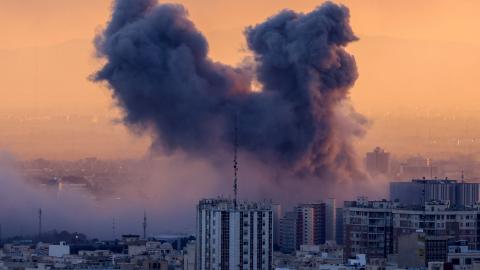




Some of the risks for global security in 2026 are obvious — such as increasing tensions between the United States and China, the grinding continuation of the Russo-Ukrainian War, more direct conflict between the United States and Venezuela, and a return to major fighting between Israel and the Palestinians — even if the solutions are less clear. However, governments must also prepare for the many less apparent risks, so we asked three experts to identify one important but underrated risk to global security to watch for in 2026.
The following section presents Patrick Cronin’s contribution to a three-section expert analysis.
The most underrecognized risk of 2026 is not a single crisis but a cascade that could precipitate the collapse of the postwar regional order. The warning signs were already visible in 2025: a U.S. strategy increasingly centered on homeland defense; allies preparing for strategic self-sufficiency; a Russia convinced that time is on its side in Ukraine; a North Korea confident that it can bunker behind Moscow and Beijing; and, most consequentially, a China that judges national rejuvenation — including Taiwan’s absorption into the Chinese Communist Party system — as attainable. The most dangerous trigger might not be war but an economic shock, accelerated by tariffs, techno-nationalism, protectionism, diplomatic paralysis, and unresolved flashpoints. This is a low-probability but high-impact scenario. Yet, the Indo-Pacific regional order — now indistinguishable from the global order — is too central, too interconnected, and too systemically important to fail without catastrophic consequences.
Read the full article with the other authors’ sections here.