












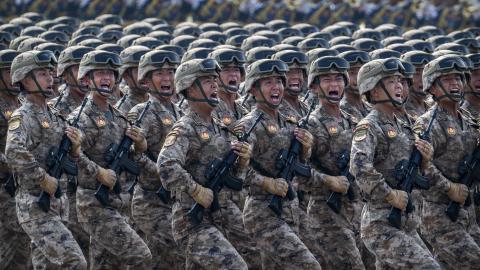
“We are facing stormy seas. Be ready for war. Be ready to fight a war at any time.” Since 2018 Chinese President Xi Jinping has spoken these words dozens of times.
He has seized power from the committees for himself. He has purged military and political officers who disagree with his impatience to achieve what he calls the great rejuvenation of China.
There is a rule of thumb that is reaffirmed throughout history: If a dictator is rearming and openly telling his military and countrymen that a great battle is approaching, then it is prudent to believe him.
Let me present some facts about what has been happening in our region:
- For three decades, the annual increase in China’s military budget has been twice as rapid as its economic growth.
- This is the fastest and largest rearmament program by any nation during peacetime in 200 years of recorded economic history.
- China now spends more on its military each year than the combined military budgets of the rest of Asia and the Pacific.
- It has entrenched a policy known as civil-military fusion, which basically means that any commercial asset or technology can be commandeered by the state for military purposes.
Australian officials and military experts speak about the loss of strategic warning time when we should prepare for war. This is a collective failure on our part.
You have probably heard this apparently sage advice: if we treat another country as an enemy, then we make it into one. I prefer a more practical approach. If a country is preparing for war against us, we should take it seriously: whether this is to deter or to fight. The process is the same. We have refused to heed the public warnings Xi has delivered for years.
Some may be thinking: what is the point? Australia is a population of under 28 million people against China’s 1.4 billion. Our GDP is one-tenth that of China’s, as is our military budget compared with the People’s Liberation Army.
Paul Keating is a constant critic of our alliance with the US and of agreements such as AUKUS. He has argued that pitting our military against China’s is like “throwing toothpicks at a mountain”.
Why take on a giant when Australia is under no threat of direct invasion? China openly wants to take Taiwan. This will allow it to break out into the Western Pacific and beyond, thereby surrounding and isolating Japan and the Southeast Asian states. It wants to control how our region operates by dismantling the US alliances with Japan, South Korea, The Philippines and Australia.
The numbers reveal and dictate the Chinese strategy. If the US is eased out of the region, there is no possible military or economic balance that can keep China in check.
China does not have to become more powerful than the US. It just needs to weaken or neutralise American alliances because the US cannot sustain its position in our region without the assistance of allies. This is why China is constantly urging and demanding that Australia remain neutral and on the sidelines. It is a clever strategy to ensure there is no possible deterrent.
You still may wonder: so what? There is about 7250km between northern Australia and the southern tip of China. Keating and others are correct: we are unlikely to see an invasion of Australia under any circumstances. But it comes down to the terms by which we exist as a sovereign and independent country. What might China want and demand from Australia if Xi achieves economic and military dominance in the region?
Well, it would buy our iron ore at prices well below the global commodity market price. It will insist on purchasing our mineral and agricultural assets without restriction and sell these commodities to the Chinese market at below market prices. The way would be clear for China to entrench an exclusive military and police presence in the South Pacific. In controlling shipping lanes and market access in the entire region, it would punish Australian governments or firms when they make decisions that Beijing does not like. It would openly monitor the activities of Chinese diasporas in Australia and insist that those critical of China be punished or even extradited to China for detention.
If you think I am exaggerating or speculating, just remember the 14 grievances the Chinese embassy issued to Australia back in November 2021 as justification for the economic punishments against us.
Of those 14 grievances, nine concerned our domestic policies. In other words, the Morrison government could have remained silent on the treatment of Uighurs in Xinjiang, on the threats being made against Taiwan and on the illegal Chinese claim to all of the South China Sea. That would not have been enough to avoid punishment. According to the 14 grievances, we also needed to clamp down on our domestic media, remove hurdles for Chinese firms wanting to control Australian assets, defund think tanks critical of Chinese policies and allow firms such as Huawei to dominate our critical infrastructure and technologies.
There won’t be a PLA invasion of Australia but how we live and exist as a country will be very different from what we now enjoy. If you still don’t believe me, look at countries such as Cambodia, Laos or even Malaysia. You can see for yourself how much China has restricted their ability to make sovereign decisions for themselves.
Why do we need to spend more on defence if our military cannot make a difference when it comes to deterring China? Why do we need AUKUS?
The answer is that we can make a difference and China knows it – which is why Beijing is hoping we will not properly fund AUKUS.
The one thing we have that is irreplaceable in strategic terms is geography. Japan is called the northern anchor of the US-led alliance. We are known as the southern anchor.
It’s not the only thing the Australian Defence Force brings to the table. It is also the use of our territory for hosting satellite and other technological assets that is needed by modern militaries, including planes, such as the F35.
Our bases in the Northern Territory can provide munitions and stores of fuel and other military needs. Shipyards in Western Australia can service allied ships and submarines to increase the number of these that are operational and in the fight at any given time.
In a prolonged war, and that is what it is likely to be if one begins, say over Taiwan, the great allied weakness is adequate supply chains. Australia becomes critical in this respect.
To prevent a war, we need to convince the Chinese that we will collectively fight and can prevail in a war. In this context, Japan is the most important ally. Australia is next. If allies are not fully committed, the US cannot provide that check in Asia. China wins – without a shot being fired.
If China gets its way, the Australian way of life based on being able to make our own decisions and live the way we have grown accustomed will change.
Our current defence budget does not allow Australia to play this necessary role. Don’t blame Donald Trump for our predicament.
His accusation that allied free-riding weakens all of us is correct. He might be transactional. But the deal is this: the more we do for ourselves, the more America will do for us. And the reverse holds true.
Allow me to end on a personal note. And I hope I am not insulting any of you by saying this.
I migrated here from Malaysia in 1980. What it means to be free and sovereign in Australia is far more meaningful than from where I was born. It often takes someone who has lived overseas to know there is a difference.
I began with a quote from Xi Jinping and I will end with another. Every time Xi sees Vladimir Putin, he says: great changes, unseen for a century, are occurring. He refers to the decline and eclipse of the West because he believes we are indulgent, distracted, divided and not ready for what is to come. He must be proved wrong.