










In China's Sights
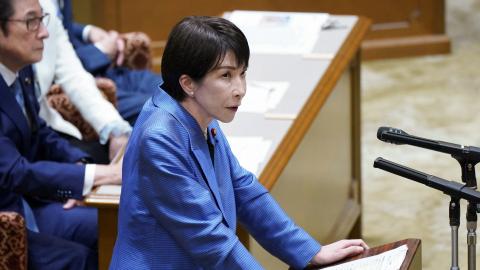
Recently, Beijing's foreign policy leadership had appeared to be making an effort to send its Wolf Warrior diplomats back to their lairs ー until Japan's Prime Minister Sanae Takaichi spoke truth to power in her remarks to the Diet. She observed that China's use of force in a potential Taiwan contingency could present Japan with "a survival-threatening situation."
In response, the Wolf Warriors were soon out of their dens. China's initial salvo came from Osaka Consul General Xue Jian. He advocated decapitating the Prime Minister, arguing "to cut off that dirty neck without a second of hesitation."
China's Ambassador to the United Nations, Fu Cong, followed up. In a letter to the UN Secretary General, the ambassador called on Japan to "stop making provocations and crossing the line, retract its erroneous remarks." Cong warned Japan that armed intervention would be considered "an act of aggression."
Beijing then turned up the heat, with Foreign Minister Wang Yi finding the Prime Minister's remarks "shocking" and promising that China would "resolutely respond." The Foreign Minister went on to declare that the international community is duty-bound to "prevent the resurgence of Japanese militarism." President Xi followed up in a telephone call to President Donald Trump, in which he raised the Taiwan issue.
Foreign Ministry spokesperson Mao Ning has explained that Takaichi's "wrongful remarks have seriously hurt the feelings of the Chinese people and poisoned the atmosphere for people-to-people exchange." Accordingly, Beijing issued personal safety warnings for its citizens traveling to Japan.
That was only the start.
China's Global Wolf Warriors
Beijing then re-opened its economic sanctions playbook, reimposing a ban on the import of Japanese seafood products and suspending the December 5 scheduled release of the Japanese animated movie "Crayon Shin-chan." Then, on November 16, it sent Chinese Coast Guard ships into the waters of Japan's administered Senkaku Islands.
The response came with a warning of more to follow unless the Prime Minister retracted her "wrongful remarks." In itself, though, that warning violated China's own sacrosanct principle of non-interference in domestic affairs.
Beijing's efforts at economic intimidation are not new. We've seen this movie before.
To Review:
2010:
China embargoed rare earth exports to Japan in response to a fishing boat incident in the Senkaku Islands. It also delayed customs clearance procedures and suspended high-level diplomatic and political contacts. Meanwhile, it allowed anti-Japanese sentiment in China to run rampant against Japanese companies, also endangering the safety of Japanese residents.
2017:
Responding to Seoul's decision to deploy the THAAD missile defense system, Beijing banned group tours to South Korea. Likewise, it encouraged a boycott of South Korean products, cancelled performances of K-pop entertainers, and suspended cultural engagements.
Beijing also imposed a diplomatic "Three Noes" diktat on Seoul – no further THAAD deployments, no participation in a US missile defense architecture, and no participation in a US-Korea-Japan partnership. (In 2022, Seoul declared the Three Noes inoperative.)
2020:
The Australian government called for an inquiry into the origin of the COVID-19 pandemic. Beijing, to show its displeasure, responded by calling Australia "gum stuck to the bottom of China's shoe" and acted to restrict Australian exports, including wine, barley, coal, cotton, and lobsters. This led Australia's companies to successfully diversify export markets.
2021:
And just to underscore that the Wolf Warriors are global in outlook, in November 2021, Beijing slapped a trade embargo on the Lithuanian government and downgraded its diplomatic presence in that country. It blamed the action on Lithuania's decision to allow the opening of a Taiwan representative office in Vilnius. China called that act a "blatant breach of faith."
So, what is to be done?
1. A Diplomatic 'Wolf in Sheep's Clothing'
First, is to recognize that for all of Xi Jinping's Global Governance call for a new world order, China remains a diplomatic "wolf in sheep's clothing." Despite the well-tailored suits of its diplomats, at heart, it is a schoolyard bully.
2. Strengthen the US-Japan Alliance
Second is to join with Ambassador to Tokyo George Glass in thanking China for all that it is doing to strengthen the US-Japan alliance. At a time of much uncertainty with respect to the direction of US foreign policy, Washington needs all the help it can get. So again, makoto ni domo arigatoo gozaimasu. ー sincere thanks.
3. Remember Abe's Syllogism
Third, as for Taiwan, as former Prime Minister Shinzo Abe cautioned, remember that a "Taiwan contingency is Japan contingency" and therefore a contingency for the Japan-US alliance. Abe's syllogism reflects strategic realities.
The growing realization of Japan's potential involvement in a Taiwan contingency has served to shape the evolution of Japan's defense and national security policies. Its strategic shift to the Southwest islands began under the 2010 National Defense Program Guidelines and the Mid-Term Defense Plan. Japan's 2022 National Security Strategy and subsequent defense policy documents have reinforced this direction.
The increasing deployment of the Self-Defense Forces to the southwest islands, joint exercises with US forces in the region, and the development of civil defense and evacuation plans in the event of conflict all reflect the reality of a potentially existential Taiwan contingency for Japan.
4. Japan's Peace and Security Legislation
Fourth, to remember the language of Japan's 2015 Peace and Security legislation. As Takaichi has reminded the Japanese public and the Chinese Communist Party leadership in Beijing, it reads:
- When an armed attack against Japan occurs or when an armed attack against a foreign country that is in a close relationship with Japan occurs and as a result threatens Japan's survival and poses a clear danger to fundamentally overturn people's right to life, liberty and pursuit of happiness*,
- [And] when there is no other appropriate means available to repel the attack and ensure Japan's survival and protect its people,
- Use of force should be limited to the minimum extent necessary.
* As a matter of course, use of force must be carried out while observing international law. In certain situations, this is based on the right of collective self-defense under international law.
In short, an armed attack on US forces during a Taiwan contingency could present Japan with a survival-threatening situation.
The Prime Minister was simply acknowledging a potential national security reality in her remarks to the Diet. At the same time, her comment enhanced alliance-based deterrence against that contingency.
Candor is not often recognized as a political virtue. When it does appear, it should be respected.