











Executive Summary
- Ukraine begins to withdraw from Pokrovsk: The Ukrainian high command acknowledged it is initiating partial withdrawals from the embattled city of Pokrovsk, though minor tactical engagements continued there.
- Battlefield assessment: The number of tactical engagements decreased across the battle space last week, due either to a planned operational slowdown or to the effects of harsh winter conditions on combat operations.
- Russia’s air war: November marked the third consecutive month in which Russia has launched more than five thousand Shahed drones at Ukraine.
1. Battlefield Assessment
In stark contrast with the intense operational tempo of recent weeks, the number of tactical engagements declined across the battlespace last week, on some days numbering fewer than 100. Deep mud made it more difficult for both Russia and Ukraine to move materiel and men.
Despite the overall decline in the number of combat engagements, fighting remained fierce where it occurred. In the southern parts of the city of Vovchansk, for example, Russian forces repeatedly attempted to breach Ukraine’s lines of defense. The axis leading to Kostiantynivka absorbed more than two dozen assaults over two days. Huliaipole, a small city in Zaporizhzhia Oblast, also saw intermittent clashes, while Orikhiv and the banks of the Dnipro River remained largely static.
Ukraine’s defense of Pokrovsk continued to deteriorate. The Russian military has combat deployed more than 150,000 troops—a contingent larger than the full-time armed forces of the United Kingdom—to the relatively small area of operations surrounding the city. Ukrainian press reported that more than half of the cluster munitions that Russian forces used last week hit the Pokrovsk front.
Ukrainian officials acknowledged they had initiated withdrawals around the city, but still deny that the critical stronghold has been completely lost. Open-source intelligence indicated that Ukrainian combat formations, including the 25th Airborne Brigade, remained in the Pokrovsk sector. Nonetheless, Ukraine’s 7th Rapid Response Corps has moved its combat formations to better-fortified positions to avoid being surrounded or caught off guard.
Fighting also raged in the direction of Kupiansk, with Ukrainian forces repelling several Russian attacks near Petropavlivka and Pishchanye. The Lyman–Sloviansk corridor also became a focal point as Russian assaults pushed into Ukrainian positions there, though with limited results.
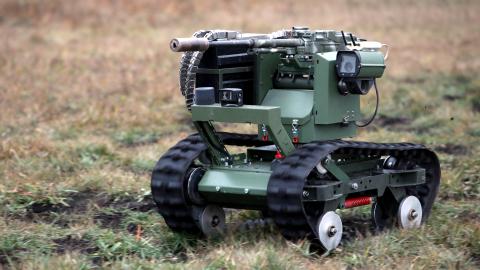
With round-the-clock drone surveillance, dangerous minefields, and artillery kill boxes attritting Ukraine’s forces, the Russian military has also increased its use of unmanned ground vehicles (UGVs). Visuals from the battleground suggest that Russia has used UGVs in both strike and support missions, such as demining and logistics. Moscow has also modified its Courier-class UGV baseline for electronic warfare roles.
Russia also kept up the grinding pace of its air raids. Hundreds of drones, predominantly Shahed-baseline loitering munitions, rained terror onto Ukraine’s civilian population. Airstrikes hit Kurylivka in Kharkiv Oblast, villages across Donetsk, and multiple locations in Zaporizhzhia.
Ukraine continued to fight with characteristic tenacity, however, ceding ground only where necessary and inflicting high costs on Russian combat formations. Winter has degraded the battlefield, but it has not broken Ukraine’s defenses. The war continues to be characterized by endurance, improvisation, and the resolve of units fighting village-to-village across a vast front.
General Oleksandr Syrskyi, chief of the Armed Forces of Ukraine, stated last week that Ukraine’s defenses are facing one of the most demanding phases of the war, as Russia has intensified its offensive pressure in challenging winter conditions. When Ukraine strikes Russia, it does so mostly via its capable drone warfare deterrent, which is now responsible for roughly 60 percent of Ukraine’s successful strikes. Ukrainian drones have recently focused on remote mining operations and on targeting Russian drone operators.
Ukraine also continued to wage its deep-strike campaign against high-value Russian assets. During the night of December 9, Ukraine’s Special Operations Forces (SSO) used drones to strike a weapons depot belonging to Russia’s 9th Motorized Rifle Brigade in occupied Donetsk Oblast. According to official Ukrainian sources, the depot housed multiple reconnaissance-and-strike unmanned systems.
The SSO also reached deeper into Luhansk, reportedly striking the Yug Military Transport Enterprise and setting ablaze roughly 6,000 cubic meters of stored fuel. Additionally, multiple branches of the Ukrainian military conducted a joint strike on the Ryazan oil refinery, one of the largest oil refineries in Russia. In a conflict defined by logistics as much as firepower, the destruction of Russian fuel reserves in the occupied territories of Ukraine could threaten the maneuverability of Russia’s tactical combat formations.
2. Heavy Shahed Salvos Continue
In November Russia launched a total of 5,445 Shahed-variant drones at Ukraine. Of that total, Ukrainian authorities recorded 2,939 kills and claim to have intercepted roughly 4,560. Even this high interception rate (84 percent) would mean that 826 Russian drones struck their targets last month.
November marks the third consecutive month that Moscow has fired more than five thousand of the Iran-designed loitering munitions at Ukraine. The median Russian strike package consisted of 129 drones, with an average decoy rate of 38 percent, reflecting Moscow’s continued use of swarm tactics and the growing sophistication of its efforts to saturate and confuse Ukrainian air defenses.
In an illustration of the high operational tempo of the conflict’s drone warfare, Russia launched at least one drone attack on Ukraine every day in November. Moscow directed most of its Shahed raids at Ukraine’s critical infrastructure. In addition to its drone salvos, Russia also hit Ukraine with indigenous and North Korean cruise, ballistic, and aeroballistic missiles.
3. What to Monitor in the Coming Weeks
- Operational tempo: This report closely tracks each week’s operational tempo and total tactical engagements. Following a recent peak—possibly due to the Russian push for Pokrovsk—tactical engagements decreased slightly last week. This decline can be attributed to either winter conditions or a temporary operational slowdown. Analysts should keep an eye on this statistic to understand the battle space and what may come next.
- The situation in Pokrovsk: While the Russian military has the upper hand in the struggle for the embattled city, Ukrainian resilience has kept the Kremlin’s forces engaged. Pokrovsk will bear close monitoring in the coming weeks as fighting continues.