














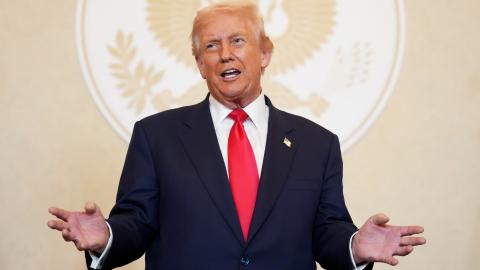
On Thursday evening, the Trump administration released its long-awaited National Security Strategy, articulating its worldview and foreign policy priorities. China features heavily in the document: it is the most frequently mentioned country, and even when not named explicitly, is clearly the driving force behind many priorities.
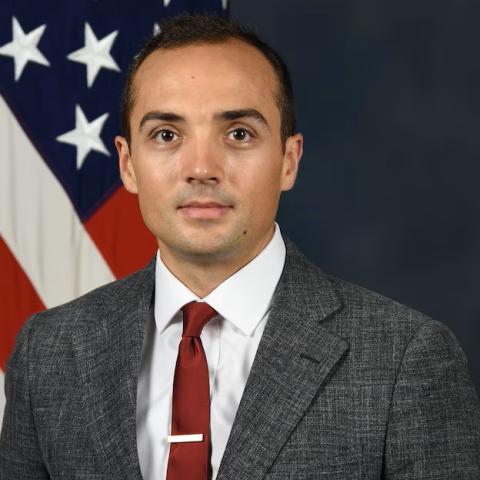
To assess the latest strategy, The Wire China spoke to Nadia Schadlow, a senior fellow at the Hudson Institute, a conservative Washington think tank. As U.S. deputy national security advisor for strategy in the first Trump administration, Schadlow led the drafting and publication of the previous Trump National Security Strategy. We discussed what's changed, and what hasn’t, with this latest report.
Q: What are the main differences in approach to China from Trump 1.0 to 2.0?
A: I don't see significant differences in Trump's approach to China. There’s consistency in terms of seeing China as an economic competitor that continues to use its unfair trading practices to distort global trade. There's consistency in terms of seeing China's efforts to dominate the Indo Pacific, and consistency in seeing China as a technological challenge because of its control of critical inputs into our tech supply chain. So I see a lot of consistency in those areas.
Do you see a dovish shift in the new strategy towards China at all? Some people have interpreted it that way given language about a “maintaining a genuinely mutually advantageous economic relationship with Beijing.”
No, I don’t. I can point to as much language in the new strategy that articulates China as an ongoing, serious problem, but at the same time, I think the White House wants to preserve room for negotiation with China. That's how I would interpret that point.
A theme that runs through the document is the desire for stability, but not at the expense of undercutting American interests. I think that that holds in terms of the language about China. There's a desire for stability, but everything in the document that articulates American interests — about maintaining our innovative economy, maintaining the dollar as a global reserve currency, maintaining technological dominance, maintaining the world's most powerful and capable military — will require a more hawkish approach toward China, because China is an obstacle to achieving most of those objectives.
There are several sections of the strategy that seem to be all about China, but don’t mention it by name. For example, the threat of “any competitor” controlling the South China Sea, or protecting the economy from “any country or source” of issues such as predatory, state-directed subsidies. That seems different from the 2017 National Security Strategy you helped write, which was often more explicit. How do you interpret that? Why the caution about referring to China directly?
China is mentioned in the strategy 21 times. I wouldn’t interpret that as caution. My sense is that there is a desire from the White House and President Trump to keep lines of communication open and leave the option for a future summit with China. That's how I interpret it. Nonetheless, as I noted earlier, I see throughout the strategy references to China's problematic behavior as well, especially in terms of trade.
There's also a reaffirmation of America's status quo policy toward Taiwan that is pretty strong, and a recognition of Taiwan's importance, not only in terms of its production of semiconductors that drive much of the world’s economy, but also its importance for freedom of the seas and the U.S. economy. I found that language to be pretty strong and I don't think that that's going to make the CCP happy.
So you see continuity in this strategy in terms of how the administration regards the status of Taiwan?
Look, it says quite explicitly “deterring a conflict over Taiwan by preserving military overmatch is a priority.” That's strong and direct language. “We will also maintain our longstanding declaratory policy on Taiwan, meaning that the United States does not support any unilateral change to the status quo in the Taiwan Strait.” I think that’s positive.
A notable change seems to be the strong focus on the Western Hemisphere and reassertion of the Monroe Doctrine. Does that mean the U.S. is going to consider the Americas' relations with China differently from say, how it considers Europe's relations with China?
No, I think it describes a determination to make sure that the Western Hemisphere does not become manipulated and dominated by China, and I think that's a good thing. I don't think it's a surprise that the Western Hemisphere plays a prominent role in this strategy because of the region’s direct linkage to the problem of illegal migration. Concern over illegal migration was a key theme of Trump 1.0. It has become stronger in Trump 2.0 because of Biden's open border policies. But I see this elevation as a good thing vis-à-vis China, because it also intends to make it harder for competitors like China to increase their influence in a region close to the United States.
I guess some would question, why isn't China mentioned by name [in the section about the Western hemisphere]? But I think the strategy is still basically putting down a marker and saying, we are going to be watching if competitors like China try to increase their influence in the region and manipulate trade relationships to harm American interests. I think that's positive too.
From your experience writing the 2017 National Security Strategy, how do you balance different agencies' interests when drafting such a document? One commenter has described this strategy as less an imposition of order on the interagency and more a “ceasefire agreement between warring camps.” Would you agree with that characterization?
This strategy is a White House document that can drive the respective agencies in positive directions. I see this as a good strategy, something that the Department of Treasury, Department of Commerce, Department of Defense and the State Department can get behind. I was not involved in the internal workings of this particular strategy, but from my perspective on the more China hawkish side, I see this strategy as one which will be very useful in terms of telling the agencies: here are a set of objectives, now get on board, and go forth and implement. It gives all of the agencies plenty to do, building on Trump 1.0 and the past year of Trump 2.0.
Overall, I see this as a document that says unequivocally, America is a strong, confident nation that wants to exert its power to ensure stability and a balance of power. That’s a good thing — for us and our allies and partners.