













On December 12, 2025, Hudson Institute’s Center for Peace and Security in the Middle East hosted a conference titled “Antisemitism as a National Security Threat” to examine how antisemitism, both foreign and domestic, threatens American security and Western civilization. The below readings were selected to inform those conversations.
Foreword
Michael Doran
Part I: What We’re Fighting Against
The “Jews” Are a Proxy for a Far Bigger Political Fight
Michael Doran
Antisemitism Is a National Security Threat
Liel Leibovitz
City Journal
The Woke Jihad
Abe Greenwald
Commentary Magazine
We Have Been Subverted
Ayaan Hirsi Ali
The Free Press
What the Right Gets Wrong about Zohran Mamdani
Zineb Riboua
The Right’s 1939 Project
Rebeccah L. Heinrichs
Antisemitism Poisons America
Walter Russell Mead
Part II: The Path Forward
End US Aid to Israel
Jacob Siegel and Liel Leibovitz
Tablet Magazine
Christianity and National Security
Rebeccah L. Heinrichs
Will Washington Learn from Israel’s Strikes?
Michael Sobolik
Foreword
Antisemitism is a uniquely protean phenomenon. One moment Jews are uprooted cosmopolitans dissolving nations; the next they are ethnonationalist zealots clinging too fiercely and clannishly to their own. They are simultaneously hyper-assimilated and insufficiently assimilated, too particular and too universal, too powerful to oppose and too weak to respect. This is the only prejudice that blames the same people for inventing and promoting capitalism while also undermining it by inventing and promoting communism. Antisemitism wraps itself in human rights language to strip Jews of rights—proclaiming anti-fascism while employing fascist tactics and preaching anti-racism while indulging in bigotry against Jews.
Antisemites of all political stripes refashion Jews into whatever archetype their prejudices require, imputing to them whatever transgression best serves their chosen narrative. Consider the phantasmagoria of today’s leading antisemite, Tucker Carlson. In his broadcasts, Jews steer the United States into global wars, shape the rise and fall of empires, and determine when nations fight and when they make peace. He accuses them of possessing advance knowledge of catastrophes like 9/11, directing US foreign policy from behind the curtain, and imprinting their designs on everything from media narratives to American grand strategy. The content of any individual claim is irrelevant. What matters is the role Carlson assigns to Jews: figures that transcend ordinary human motives and unilaterally bend the arc of history.
This is what makes the subject of our conference—antisemitism as a national security threat—so difficult. Antisemitism is ancient yet endlessly adaptive. It is constantly absorbing and repackaging ideological material for evolving audiences and mediums. And national security is itself a broad concept, comprising threats foreign and domestic, military and civil, material and psychological.
To arrive at practical solutions and achieve a deeper understanding of the issue, we therefore need to avoid two distinct traps. We should first be wary of focusing on such a narrow subset of these issues that we miss the bigger picture. But we also must avoid the temptation of seeking to map the entire ocean. Our goal is not to survey antisemitism in all its forms but to examine specifically its national security dimensions. To strike the proper balance, we are grounding this conference in three key topics.
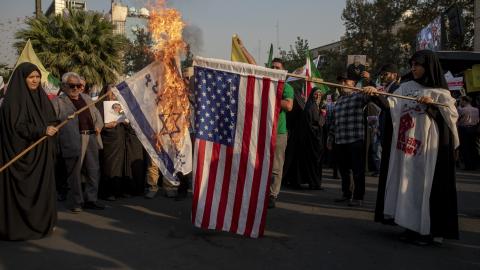
First, we will discuss antisemitism as a tool of our geopolitical adversaries. The axis of China, Russia, Iran, and North Korea now runs coordinated campaigns to spread antisemitism and exploit existing currents of hatred within the United States. They deploy it not merely as propaganda but as a strategic instrument to weaken American power, fracture social order, and realign US strategy to serve their revisionist interests. Antisemitism threatens to corrode America’s indispensable partnership with Israel, its strategic advantages over authoritarian adversaries, and the civic foundations of our nation.
Second, we will examine antisemitism as a key plank in transnational progressivism. Those who championed the Joint Comprehensive Plan of Action and the 1619 Project have since seized the opportunity to mainstream antisemitic narratives. American universities, parts of the permanent bureaucracy, and media outlets such as Haaretz promote ideas that—often unconsciously—aid US adversaries. Tucker Carlson and his cohort, for all their anti-leftist signaling, are aligned with the progressive left on this point.
Third, we will identify how antisemitism weakens America’s geopolitical posture. US competition with the authoritarian axis is global. But antisemitism blinds Americans to rising Russian and Chinese influence in the Middle East—a key chokepoint for trade and energy flows—and obscures a fundamental strategic truth: that Israel’s military and diplomatic success advances US interests.
Meeting this challenge in a fragmented information environment with shifting political alignments will require a coordinated, multidimensional, and international strategy. That is why we are gathered here today. Hudson Institute’s Center for Peace and Security in the Middle East has convened policymakers, experts, community leaders, and practitioners to provide solutions—concrete proposals for safeguarding America’s strategic position, restoring civic confidence, and ensuring American prosperity at home and strength abroad. We will address issues ranging from the battlefields of the Middle East to the “tentifadas” on American campuses—because national security goes beyond diplomacy, intelligence, and warfare.
This collection of essays is designed to inform these conversations and highlight the rising strategic importance of combating antisemitism. As a policy community, we owe it not only to American Jewry but to all Americans to confront—directly and without equivocation—the ideologies that threaten US national security and the endurance of Western civilization itself.
Michael Doran
Senior Fellow and Director, Center for Peace and Security in the Middle East
Hudson Institute