











Executive Summary
- Battlefield assessment: The Russian military intensified its offensive pressure and made meaningful battlefield gains. The fall of Pokrovsk seems almost inevitable, and neighboring Myrnohrad is also at risk.
- Ukraine strikes shadow tankers: Ukrainian Sea Baby naval drones hit two Russian shadow fleet tankers in the Black Sea. Damaging these vessels highlights Russian sanctions evasion and could serve as a new strategy to restrict Moscow’s energy revenues.
- What to monitor: Russia has begun to equip Shahed-baseline drones with air-to-air missiles, raising the risk that Moscow will attempt a false-flag operation over Europe.
1. Battlefield Assessment
Fighting raged at a high operational tempo across the Ukrainian battle space last week, with some days seeing between two and three hundred tactical engagements.
This pronounced increase in combat activity highlights the mounting pressure Russian forces are placing on Ukraine. Some sources report that Russia seized about 90 percent more Ukrainian territory in November than in October. In a worrying trend for Kyiv, Russian formations are now targeting the anti-drone infrastructure Ukraine has built along critical logistical routes.
The Pokrovsk and Kostiantynivka fronts bore the brunt of Moscow’s assault. The Russian Ministry of Defense announced that its forces had successfully captured Pokrovsk. While Kyiv has not officially confirmed the city’s fall, the situation there appears all but irreversible. Heavy fog and harsh winter conditions have allowed Russian small-infantry assault teams to penetrate Ukrainian defenses. Russian units have also surrounded the nearby city of Myrnohrad, which may soon fall as well.
Other flashpoints also bear monitoring. In recent weeks the Russian military has been pushing hard and gaining ground in Zaporizhzhia and in the direction of Lyman. In Kupiansk, where this report detected prior Russian infiltrations, the Ukrainian General Staff has focused on detecting breaching Russian assault groups as it sweeps the city and its outskirts.
Detailed analysis of battlefield debris suggests that Russia is now equipping its Geran loitering munitions (Russian-manufactured versions of Iranian Shahed drones) with cluster warheads. (For more on Russia’s recent drone developments, see section 3.) The Russian military has used these drones against Ukrainian residential neighborhoods in Vyshhorod.
In turn, Ukraine also continued to conduct deep-strike drone salvos. In a recent attack, Kyiv targeted a Russian Federal Security Service (FSB) building in Chechnya, a semi-independent autonomous republic of Russia ruled by the pro-Kremlin strongman Ramzan Kadyrov.
2. Ukrainian Drones Strike the Russian Shadow Fleet
On November 28, Ukrainian Sea Baby unmanned surface vessels (USVs) struck two Russian oil tankers, the Kairos and the Virat, in the Black Sea. The tankers are part of Russia’s shadow fleet, a group of ships that Russia uses to evade Western sanctions.
Kyiv appears to have calibrated the strikes to disable—rather than sink—the tankers, likely to avoid a maritime dispute with Türkiye and other Black Sea nations.
The tankers were heading toward Novorossiysk, one of Moscow’s critical export hubs on the eastern Black Sea coast. According to Ukrainian intelligence, the vessels were collectively capable of hauling roughly $70 million worth of goods. Imagery intelligence suggests that both ships suffered significant structural damage. Press sources report that the Virat, sanctioned by the European Union and the United States, had spent most of the year loitering in the western Black Sea following its addition to the US sanctions list in January. The Kairos, sanctioned by the EU in July, had recently delivered Urals crude oil to India and was returning to Novorossiysk when it was hit.
Russia’s shadow fleet has become a key enabler of the Kremlin’s wartime economy. The maritime network of hundreds of crude and product carriers transports the bulk of Russia’s oil exports, allowing Moscow to sidestep Western sanctions and keep its hydrocarbon revenues flowing. These illicit tankers now constitute a meaningful share of the world’s energy-shipping vessels.
The shadow fleet exploits the gray areas of maritime governance. These vessels, registered under jurisdictions with limited enforcement, routinely go dark by disabling their automatic identification system (AIS) beacons then conduct ship-to-ship transfers in the eastern Mediterranean and off West Africa. Many are aging tankers purchased on secondary markets.
Russian Ship-to-Ship Transfer Procedure
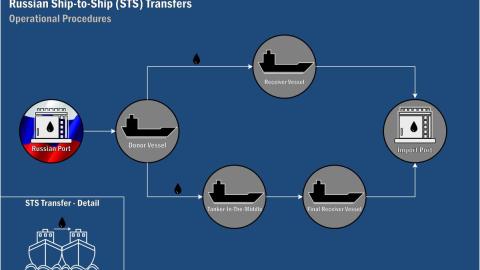
Graphic via the US Naval Institute using information from the Royal United Service Institute.
The fleet’s activities have become harder to ignore since late 2024, when a series of undersea cable disruptions in the Baltic Sea bore signs of Russian involvement. On December 25 of that year, Finland detained the tanker Eagle S, suspected to be part of Russia’s shadow fleet, after the Estlink 2 power cable between Finland and Estonia was severed, likely by a dragged anchor. European investigators had already been probing similar incidents that cut cables between Lithuania and Sweden and between Finland and Germany earlier that autumn.
This pattern suggested a hybrid campaign in which Russian commercial vessels not only help the Kremlin evade sanctions, but also conduct systematic sabotage. Ukraine’s attacks on the Kairos and Viratbring global attention to Russia’s increasing reliance on illicit commercial vessels to finance its war and shape the strategic environment through hybrid warfare. Ukraine’s strikes likely presage a new and more aggressive naval strategy for Kyiv.
3. What to Monitor: Dangerous New Russian Drone Technologies
Russia’s recent deployment of a Geran-2 attack drone equipped with an R-60 air-to-air missile introduces a new threat to both combat aircraft and civilian air traffic. This development warrants a significant answer from the US and its allies, including heightened monitoring of Europe’s airspace and enhanced strategic response planning.
A Wrecked Geran-2 Equipped with an R-60 Missile
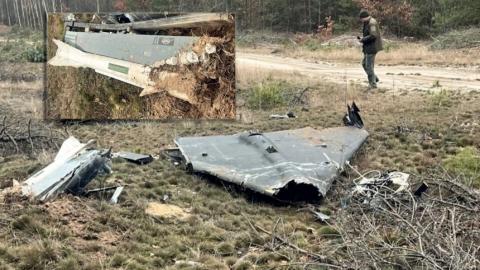
Combined image from The Aviationist. Original images via Telegram/X.
Russia’s new drone technology marks a significant departure from the Shahed variants’ role as expendable loitering munitions. The R-60, a Soviet-era infrared missile with an effective range of roughly five miles, gives the drone a new, potentially destabilizing capability. Using this new configuration, the Kremlin could run a false-flag operation wherein a missile-armed Shahed would down a Western civilian airliner and blame errant Ukrainian air defense activity.
This scenario, once the stuff of science fiction, is not entirely implausible given the pattern of Russian drone activity in Europe.