














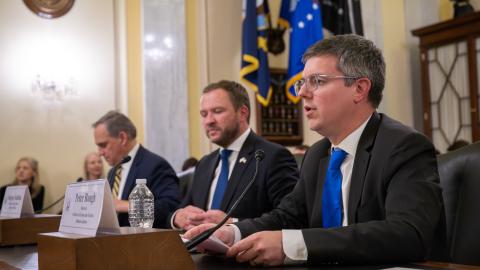
Peter Rough, director of the Center on Europe and Eurasia at Hudson Institute, testified before the United States Helsinki Commission during its “Deterrence on NATO’s Eastern Flank” hearing. The session was convened to examine Russia’s overt and covert tactics, assess North Atlantic Treaty Organization allies’ readiness to respond, and explore how the US and its partners can deter Russian aggression.
Written Testimony
Thank you, Chairman Wicker, Co-Chairman Wilson, Ranking Members Whitehouse and Cohen and distinguished members of the Helsinki Commission. It is an honor to testify before this Commission, which takes its name and mission from one of the most important international accords of the 20th century. The views I express in my testimony are my own and should not be construed as representing the official position of Hudson Institute.
Escalating Hybrid Warfare Against NATO
When as many as two dozen Russian unmanned aerial vehicles (UAVs) entered Polish airspace on the night between September 9 and 10, a swarm of unsophisticated, originally Iranian-designed but Russian produced decoy drones faced off against some of the North Atlantic Treaty Organization’s (NATO) most advanced defenses.
Just days after this incursion into Poland, another Russian drone breached allied airspace, this time over Romania, a country which has witnessed dozens of Russian military strikes near its border with Ukraine over the past three years. In many of those instances, Bucharest has reported that drone debris has fallen on Romanian territory.
These incidents in Poland and Romania, the two largest countries in Eastern Europe, are part of a broader increase in unidentified, but likely Russian, drones threatening NATO skies. In recent weeks, these UAVs have forced the temporary closure of major European airports, from Copenhagen to Munich. Earlier this month Belgian authorities spotted multiple drones over Kleine Brogel, a critical military base which reportedly hosts U.S. nuclear weapons. According to Theo Franken, Belgium’s Minister of Defense, “[i]t was not a simple overflight, but a clear command targeting Kleine Brogel.”
In one of the more brazen challenges to the alliance, on September 19, allied aircraft scrambled in response to three Russian MiG-31 interceptors after the jets had violated Estonian airspace for more than ten minutes.
In fact, all three Baltic States have recently reported airspace violations of some sort. As of this writing, Lithuania is locked in a standoff with Belarus over hundreds of weather balloons that Minsk has deployed to pressure Vilnius, causing disruptions at two of Lithuania’s international airports in the process.
While Russian hybrid attacks are familiar to many European countries, the scale and frequency of such attacks is new. In 2014, Russian sabotage operations against Czech and Bulgarian ammunition depots caught most members of the alliance by surprise. Today, Moscow regularly targets critical undersea infrastructure in the Baltic Sea; when the Kremlin jams commercial ships and planes across Eastern Europe, barely anyone bats an eye.
In Scandinavia, Sweden’s Transport Agency reports that Russian disruptions have increased “both geographically and in scope,” with the Baltic region reporting tens of thousands of GPS-disrupting incidents in recent years. In May 2024, Russian agents burned Warsaw’s Marywilska 44 shopping center to the ground in an arson operation intended to generate headlines across traditional and social media. And in July 2024, U.S. intelligence officials acknowledged a Russian plot to assassinate Armin Papperger, the CEO of Germany’s only prime defense contractor and one of Europe’s leading arms-industry figures. This marked a clear escalation from sabotage attacks against industry to the targeting of senior military industry executives themselves.
NATO member states are getting the message. Between the drone incursions over Poland and the fighter jet violations over Estonia, the North Atlantic Council convened twice in two weeks this fall under Article IV of the Washington Treaty, a clause which has been invoked only nine times in the alliance’s 76year history.
In early October, the Danish Defense Intelligence Service stated publicly what most allies know internally. “Russia is currently conducting hybrid warfare against NATO and the West,” the DDIS wrote. “It is highly likely that the hybrid threat from Russia against NATO will increase in the coming years.”
Nuclear Threats and Political War
Russian President Vladimir Putin uses nuclear signaling to complement these hybrid actions. In November 2024, Putin approved a new nuclear doctrine which theoretically lowered the threshold for the use of nuclear weapons. Last month, after Russia’s Grom strategic deterrence drills, Putin gave a highly visible endorsement of the Burevestnik cruise missile and the Poseidon torpedo, both nuclear capable strategic weapons that have global military reach.
During Zapad 2025, Russia’s major military exercise for war with NATO, Moscow simulated an Iskander short-range ballistic missile strike launch against Poland from Kaliningrad. The Kremlin has also talked of deploying the Oreshnik intermediate-range ballistic missile into Belarus, and it utilized the missile for a strike on Dnipro, Ukraine in November 2024.
Putin marries these nuclear threats to hybrid attacks to gradually tilt the security environment between Russia and NATO in Moscow’s favor. Russia’s intention is to stress the alliance and exacerbate divisions between allies and within nations. The Kremlin brackets these actions with persistent information operations.
To put it directly, Russia is prosecuting a comprehensive campaign of political warfare designed to weaken the West. There is near consensus in the analytical community that as long as Russia struggles to take territory in Ukraine, however, it cannot afford a broader war with NATO. While this judgment is almost certainly correct, it risks lulling the West into a false sense of security.
The Conventional Balance of Power and Its Limitations
Because Russia is an offensive and revisionist power, while NATO is a defensive alliance, Moscow has the advantage of choosing both the time and place of any potential confrontation. In the judgment of one senior German general officer just this month, “Russia could kick off a small-scale attack against NATO territory as early as tomorrow.”
The salient point is that while the overall military balance favors NATO by a significant margin, the balance of forces in some parts of Eastern Europe may favor Russia in a blitz scenario. As my Hudson Institute colleague, Can Kasapoğlu, has observed, Russia possesses a few meaningful yet important advantages over the alliance. For example, the high level of combat readiness among Russian troops, who are continually incorporating lessons learned from the Ukrainian battlespace, contrasts with the relative dearth of combat-ready militaries in Europe. Moreover, the NATO Force Model, under which the Supreme Allied Commander Europe is empowered to assemble 500,000 troops within 180 days, remains a theoretical instrument that has never been tested in war.
Many of those allied forces, even if mobilized and deployed, could face bureaucratic hurdles, electronic warfare attacks, and cyber disruptions while struggling eastward over bridges, through tunnels, across roads, and on rail lines built for civilian rather than for military movement. By contrast, the Kremlin can rapidly deploy its forces across Russia through an expansive rail network designed for such a contingency. Russia also enjoys a land-based, long-range strike advantage over Europe made more perilous by the post-Cold War decline in the number of air bases across NATO. Today, the alliance’s air assets are relatively concentrated.
If a conflict between Russia and the West were to drag on for weeks or months at the high operational tempo observed in Ukraine today, NATO could face some shortages. Western institutions, including the Department of War, are focused on upgrading their national defense-industrial bases. As European officials have emphasized ad nauseum, however, it will take time to build an arsenal of long-range strike assets, air-defense systems, and other critical capabilities and enablers. By contrast, Russia’s economy is on a war footing already, supported by China, North Korea, and Iran, and has used the conflict in Ukraine to innovate in key areas—especially with drones—in order to field mixed strike packages that would tax the West’s magazines.
The Response to Russia
NATO has initiated two major operations in response to Russia’s hybrid campaign. In January, the alliance launched Baltic Sentry to patrol and track Russia’s shadow fleet of tankers and other commercial vessels that sail near underwater power lines, data cables, and pipelines. The U.S. has devoted major platforms to this mission, including recently the USS Bulkeley, an Arleigh Burke-class guided missile destroyer, and has deployed P-8 Poseidon aircraft to Norway and dozens of Marines to Finland to provide support as well. Baltic Sentry has succeeded in deterring any additional sabotage in the Baltic Sea.
To replicate that success, following Russia’s drone incursion into Poland NATO recently launched Eastern
Sentry. This mission aims to integrate NATO defenses along its eastern front, from the North Sea to the Black Sea, through the forward deployment of reconnaissance and early warning aircraft, fighter jets, naval units, and air- and ground-based systems.
Forces that have forward-deployed on either a permanent or a rotational basis form the backbone of
U.S. deterrence efforts in Europe. The bulk of these forward-deployed troops are based in Germany, Italy, or the United Kingdom. U.S. commanders have testified that permanently stationed forces are invaluable for learning the local terrain and improving interoperability with allies. As my Hudson Institute colleague, Dan Kochis, has reported, “In one example, a May rotational deployment of the 3rd Infantry Division to Estonia uncovered unforeseen obstacles unique to the terrain, in terms of both scouting and vehicle maintenance.”
And yet, until it established U.S. Land Forces V Corps Forward Command at Poznań, Poland in 2023, the U.S. had no permanent force presence in the new member states of NATO, in deference to the NATO Russia Founding Act of 1997.
That political agreement with Russia lost all meaning with Putin’s full-scale invasion of Ukraine. NATO and Romanian officials have emphasized that the recent U.S. decision to rotate an 800-strong brigade of American troops from Mihail Kogălniceanu (MK) Air Base in Romania back to the United States will not create security gaps, and it is evident that the Baltic states could overcome the phase out of so-called Section 333 funding, as the Trump administration has proposed. But these decisions affect countries that have exceeded their defense spending obligations to the alliance. They are also allies which border Ukraine (in the case of Romania) and Russia (in the case of the three Baltic states). Such actions risk sowing doubts about America’s commitment to Europe in a time of war.
New Options Moving Forward
To counteract whatever misperceptions may arise from the U.S. decisions, therefore, U.S. planners should announce a permanent presence of troops in Eastern Europe. Given its strategic location near the port of Constanța on the Black Sea, Romania is transforming MK into one of the largest NATO facilities in Europe. As a key node in Europe’s security architecture, the base could serve as the ideal host for a modestly-sized permanent U.S. garrison. Moreover, such a step would inject momentum into Operation Atlantic Resolve and complement the Enhanced Forward Presence missions on NATO’s eastern flank. Similarly, Congress should restore and maintain funding for the Baltic Security Initiative.
But adopting a purely defensive posture against Russia is unwise. For the Kremlin, bribing the captains of cargo ships to drag their anchors across the Baltic seabed to cut critical cables would cost a mere pittance; the total cost to Russia of launching its recent drone salvo into Poland totaled no more than a few hundred thousand dollars.
By contrast, the NATO response to that incursion—a defensive mission to track and shoot down the Russian drones—cost millions of dollars. “It is not sustainable that you would take down thousand- or two-thousand-dollar costing drones with missiles that cost you maybe half a million or a million dollars,” NATO Secretary General Mark Rutte acknowledged in late September.
At current cost, Russia can continue its hybrid operations in perpetuity. To turn the cost-benefit calculations to NATO’s advantage, the alliance may wish to consider certain steps.
In November 2015, Türkiye shot down a Russian Sukhoi Su-24 that crossed briefly into Turkish airspace during operations in Syria. Although a tense diplomatic standoff ensued, Russia has respected Turkish airspace ever since. While this example provides an imperfect parallel when applied to drone incursions, it does pertain to fighter jet violations.
The point is not to shoot-down Russian aircraft brazenly, but to make probing operations costlier for Russia. As a first step, for example, NATO’s political leaders could get the Kremlin’s attention by tasking military commanders to reassess the Rules of Engagement for the alliance’s Baltic Air Policing mission. The Turkish case underscores that Russia respects strength, and Moscow should be made to think twice before violating allied airspace.
As for deterring drones, NATO could tie Russian violations of allied airspace to Russian positions abroad.
Ukrainian Special Forces have already targeted Wagner Group operations in Africa from Mali to Sudan.
The West could make clear to Moscow that it would encourage and facilitate similar operations against Russia’s Africa Corps, jeopardizing a lucrative Russian market, should the violations of allied airspace continue.
Although support for Ukraine through the Prioritized Ukraine Requirements List (PURL) should follow its own strategic logic, the U.S. and its allies could emphasize that there are additional weapons that could be provided at scale to Ukraine, from the Swedish-German Taurus to the American Tomahawk land attack variant known as the TLAM. Until the Kremlin gets the message, every violation of allied territory by a Russian UAV could be met with the transfer of a commensurate number of cruise missiles to Ukraine.
The U.S. also has options in the areas of cyber warfare and industrial sabotage. As President Trump demonstrated in 2018 when he authorized a covert cyberattack that took Russia’s Internet Research Agency offline, Washington possesses the cyber capabilities to deter Russian action in the cyber realm. Furthermore, while the U.S. and Europe cannot order Moscow to repair damaged infrastructure at the bottom of the Baltic Sea, it can make clear that it will exact a commensurate cost for Russian sabotage. Even after last month’s U.S. designation of Lukoil and Rosneft, for example, Moscow still earns hundreds of millions of dollars every day in oil sales. The U.S. is eminently capable of metering its sanctions to mirror Russian actions against critical infrastructure.
Although I have focused my testimony on the threat Russia poses to the West, it bears noting that China also has pernicious designs on European infrastructure. It would be a tragedy if the West took steps to protect its critical infrastructure and economic systems from Russia only for China to undermine these very efforts surreptitiously.
Moreover, taking steps to counter Russia in the hybrid domain may be for naught if the West mismanages the conventional sphere. To ensure that NATO can execute the family of plans ratified at the Vilnius Summit in 2023, NATO’s political leadership should encourage SACEUR to test the force through regular snap exercises. This would simulate high-pressure conditions and could identify shortcomings in capabilities while training the alliance to move quickly in an emergency. It is far better to strain the NATO Force Model in peacetime than in wartime.
At the same time, the U.S. should prioritize the development of military capabilities of our Eastern European allies, as spelled out in the Eastern Flank Strategic Partnership Act of 2025.
Additionally, no discussion of Eastern European security is complete without a reference to Ukraine. Its tenacity and creativity are buying the transatlantic alliance precious time to ramp up capabilities. It is in American and European interests to empower Ukraine in its fight for survival. The first billions of dollars in European commitments have served as proof of concept for the PURL system. As more European countries participate in this arrangement, the program is only likely to grow.
Ukraine also needs financing to stabilize its domestic economy and grow its defense base. The U.S. should encourage European countries to finalize a reparations loan for Ukraine that is backed by the hundreds of billions of euros in Russian assets frozen in Euroclear. This would also unlock another multi-billion dollar package from the IMF, giving Kyiv breathing space as it faces another difficult winter.
An Awareness of the Threat
In the past year, Russia has experienced three major electoral setbacks in Moldova, despite its best efforts to knock the country off its Western-oriented trajectory. In Europe’s north, Sweden and Finland are highly capable new additions to NATO. In the south, Russia has been unable to reconstitute its Black Sea Fleet, thanks to Türkiye’s invocation of Article 19 of the Montreux Convention. In Ukraine, the Russian Armed Forces have suffered at least one million casualties.
The West mostly appears to recognize the challenges it faces from Putin’s Russia. Sustained efforts to improve its capabilities will optimize Western effectiveness against Russia’s acts of hybrid warfare and prepare NATO and the United States for continued acts of aggression in the conventional domain.
Thank you for the honor of testifying before this Commission today.