














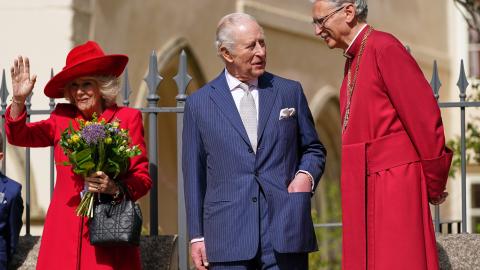
Last week King Charles III, King of the United Kingdom of Great Britain and Northern Ireland, neglected to put out a statement celebrating Easter. This is not abnormal in the history of the modern British monarchy; Queen Elizabeth only delivered one Easter message in her 70 year reign. What is abnormal is Charles III’s pattern of marking Muslim holidays like Ramadan and Eid while sidestepping Christian ones. For Holy Week in 2025, Buckingham Palace released a message on Maundy Thursday that strangely included praise of Islam’s “deep human instinct.” For Ramadan, Charles put out messages of support to British Muslims, packaged dates for Muslim families, and for the first time in its 1000 year history, opened Windsor Castle to Muslims breaking their fast.
This dynamic is even more peculiar when considering that the ruling English monarch holds the title Fidei Defensor (Defender of the Faith), signifying his role as Supreme Governor of the Church of England. Since the title was first conferred on Henry VIII by the Pope in 1521 and reaffirmed by Parliament in 1544 after breaking from the Catholic Church, few British kings have failed to live up to the title. One king however—the last Charles to sit on the throne—stands out for his failures in defending the faith, a legacy that should provide a warning to his current namesake.
Charles II was the eldest son of Charles I, the latter having been beheaded at the end of Oliver Cromwell’s parliamentary revolt against the English monarchy in 1649. Charles II briefly attempted to reclaim the monarchy after the death of his father, but Cromwell soundly defeated Charles II’s Royalist army at the Battle of Worcester in 1651, exiling him to France. Upon Cromwell’s death, Charles II returned to England and reclaimed the throne in 1660, ushering in a renewed sense of optimism after the disappointment of the Interregnum period (1649–1660) between the reigns of Charles I and Charles II, when England was a republic led by Cromwell, known as “the Commonwealth.”
Much like the current King Charles III, Charles II desperately desired to be liked by his subjects, even at the expense of maintaining any firm convictions. He promised to work with parliament, became a patron of the arts—especially the theater—and pushed for more lenient and inclusive policies in the Church of England. He reinstituted celebrations and festivals after undoing some of the more Puritan values of Cromwell.
However, the enduring legacy of Charles II is one of a prolific adulterer. He fathered at least a dozen children with various noblewomen, often the wives of his subjects. His reign, once intended to focus on reform, turned instead to scandalous love affairs and extravagant living while England economically stagnated. Historian Ronald Hutton describes Charles II’s rule as one focused on “tolerance…and the pursuit of pleasure above the more earnest, sober, or material virtues.”
Charles II showed an indifference to the Christian faith and, as his popularity lapsed, his administration began to flail. He sold Dunkirk to the French and led the nation into three unsuccessful wars with the Dutch Republic, whose failures included the Dutch Raid on the Medway in 1667, one of the most disastrous losses in the history of the English Navy. As power in his court became concentrated in a small group of English lords, his failures in governance produced the word, “cabal,” an acronym for Sir Thomas Clifford, Lord Arlington, the Duke of Buckingham, Lord Ashley and Lord Lauderdale.
Charles II produced no legitimate heir and instead presumed to pass his crown onto his brother James II, a Catholic. Parliament attempted to pass an Exclusion Bill to prevent a Catholic from assuming the throne, and Charles repeatedly dissolved parliament to prevent the bill’s passage. The episode further cemented the accusation that Charles had no sincerely held religious beliefs.
James II ultimately took the throne but would be deposed by the Glorious Revolution of 1688 to be replaced by Protestants William and Mary of Orange.
Now, another Charles sits on the throne—with his own history of infidelity and a renewed focus on so-called tolerance that often eschews the United Kingdom’s specifically Christian heritage in favor of broader pluralism, though without any firm theological basis. While only 6% of Great Britain identifies as Muslim, compared to nearly 50% Christian, Charles III has shown a style of religious pluralism that often asks Christianity to take a backseat to Islam.
Both the wife of Charles III, Queen Camilla, and the heir, William, Prince of Wales, are descendants of Charles II. If William, God willing, ascends to the throne, he will become the first descendant of Charles II to rule, only several centuries delayed. History suggests that a key to maintaining popular support, and ensuring succession, may be in fulfilling the responsibilities of the Fidei Defensor. If the king of Britain has not God, then he has nothing.