




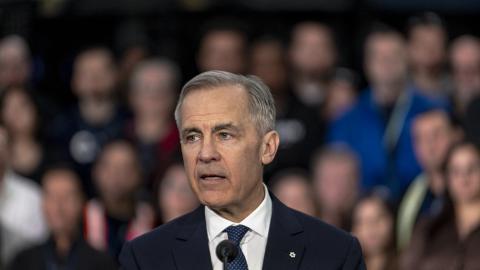
The unplanned backdrop to the visit by Canadian Prime Minister Mark Carney is the war raging in the Middle East. Since his famous address at Davos, Carney has embarked on a mission to rally middle powers to band together and reimagine a different and better order better suited to their own interests and values.
It was a gripping speech. But Carney seems to be rejecting what he argues is one fiction – that a genuine rules-based order truly existed – for another, which is that middle powers can reset the course without America. As we are seeing in Iran, and for better or worse, great powers are the primary and irreplaceable agents of continuity or change. It is a dangerous world and Carney might well be pushing a dangerous delusion.
What did Carney say at Davos that was so shocking yet compelling? He argued that the so-called rules-based order which countries like Australia and the Western Europeans clutch on to was always based on a large dose of wilful pretence and ignorance. According to Carney, we always knew the powerful would exempt themselves from espoused rules and legal constraints when convenient. But smaller powers paid insincere homage to the rules-based order because America as the hegemonic power was not challenged and provided useful public goods to the world.
This is not an original argument. Scholars of international relations from the dominant realist school have offered the same assessment of the rules-based order for decades on the basis that there is no true higher authority in the international system beyond states and material power is the final arbiter of what is permitted or prohibited. But it is unusual for the elected leader of a significant democratic power to make this point and to urge other middle powers to take matters into their own hands.
It is at this point that Carney’s clarion call runs into conceptual and practical difficulties. For a start, he concedes that middle and smaller powers faked conviction in a rules-based order because it left them free to pursue their own self-interest. If middle powers such as Canada and Australia band together against America, why does Carney assume these weaker states will suddenly abandon the pursuit of their narrower self-interest and instead demonstrate a genuine newfound nobility and altruism that he argues no country was ever able to muster in the old order?
Perhaps he believes that middle and smaller powers are more sensitive to the threat of coercion or being pushed around in other ways. If so, why has Carney remained largely silent about the undoubtedly coercive military, economic, and political actions of China against neighbours, European countries, and Canada?
Carney’s Canada prides itself on human rights and a values-based approach. In the 2025 election campaign, Carney identified China as one of Canada’s biggest threats in the form of Chinese economic coercion and foreign interference. He now wants a new partnership with China as part of a middle power-led revised order and has himself become dutifully silent about Beijing’s poor human rights record. Put aside the fact that China is not a middle power or the assessment that Beijing’s policies and actions constitute a greater systemic disruption to global order than Trump’s America. It seems Carney’s call is more about criticising Trump than the reimagining of international politics.
Another problem for Carney is that there is no getting around material power and how it is distributed. The notion of middle powers shaping institutions and building coalitions of like-minded states runs deep in Canadian and Australian diplomatic history. The most fruitful period for such creative middle-power activity was the 1990s and 2000s, which were two decades marked by little overt great power tension. International power politics was temporarily parked on the sidelines.
That benign environment has faded. This means the return of material power as the final arbiter of what is permitted or prohibited. Carney accepts this reality as he believes Canada needs to increase its military and economic power to become more relevant in the global system – although announcing an increase in defence spending from 1.4 per cent to a still paltry 2 per cent only emphasises the extent of entrenched Canadian free-riding. In other words, Carney acknowledges that one needs power to induce and coerce others, and to get things done.
But the material power gap in every way between America and China on the one hand and the middle powers on the other has widened considerably. Europe grudgingly gets it. These countries are increasing their defence spending to ensure America fulfils its commitments to NATO rather than herald in a post-American era when it comes to European security.
The Albanese government has no special fondness for the Trump administration. But it knows Chinese coercion is the greater problem and there is no alternative to American power regardless of who is in the White House. Treaties with countries such as Indonesia do not change the equation.
Carney will receive an enthusiastic and sympathetic welcome as a leader of a state that has been especially bruised by some of Trump’s policies. But the enduring relevance of his words and vision will be limited.