










Executive Summary
- Battlefield assessment: The Russian military kept an offensive footing, making limited but steady territorial gains and sustaining its attacks on Ukraine’s energy infrastructure.
- SpaceX increases cooperation with Kyiv: Ukraine’s Ministry of Defense worked with Elon Musk’s SpaceX to prevent Russia from using the Starlink satellite internet system to control drones over Ukraine.
- Russian Shahed innovations: Russia employed a new control system in its Shahed drone baseline to improve targeting.
- Advanced weapons for Ukraine: The Priority Ukraine Requirements List (PURL), a program using Canadian and European funding to provide Ukraine with weapons from the United States, continues to pay dividends for Kyiv’s war effort.
1. Battlefield Assessment
The battle space remained stable at the strategic and tactical levels last week, with Russian and Ukrainian forces waging between one and two hundred tactical engagements per day.
Familiar flashpoints again saw most of the fighting, with heightened combat activity occurring in Pokrovsk, Huliaipole, Kupiansk, Kostiantynivka, Kramatorsk, Sloviansk, Lyman, and Orikhiv. Russian forces maintained an offensive footing, gaining roughly 150 square miles of Ukrainian territory in January 2026, a slight increase from December 2025.
Russian Net Monthly Advance within Ukraine 2024–26
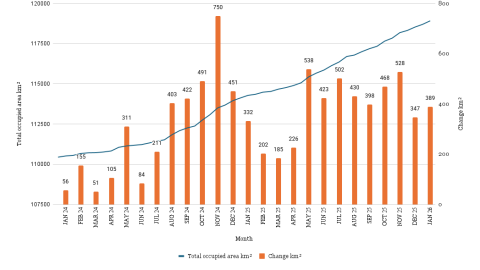
Source: Black Bird Group (@Black_BirdGroup) via X.
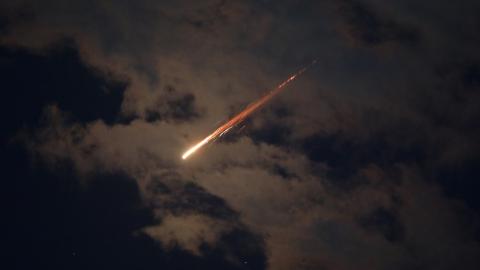
Moscow continued to target Ukraine’s energy infrastructure and residential buildings. Overnight on February 2 Russia executed a massive, coordinated strike using a combination of air- and ground-launched ballistic and cruise missiles alongside unmanned aerial vehicles (UAVs). The attack targeted Kyiv, Kharkiv, Dnipropetrovsk, Vinnytsia, and Odesa Oblasts. Russian drones operated in Ukrainian airspace well into the morning, according to Ukrainian Air Force reports.
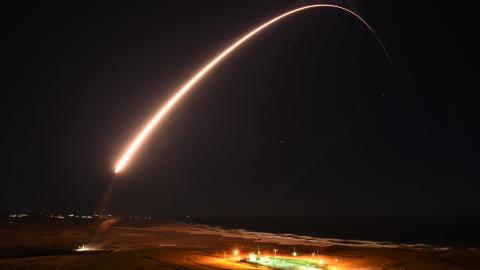
During the strike, Ukrainian air surveillance identified at least 520 Russian missiles, including Zircon high-hypersonic missiles, Iskander tactical ballistic missiles, S-300 air defense systems modified for land-attack roles, Kh-22 anti-ship missiles, and Kh-101 air-launched cruise missiles. Russian forces launched these projectiles from Bryansk and Kursk Oblasts, the Caspian Sea region, and occupied Crimea.
Russia also launched approximately 300 Shahed loitering munitions from multiple airfields. In all, Ukrainian air defenses neutralized at least 450 aerial threats through kinetic interception and electronic warfare. Nonetheless dozens of missiles and drones struck their targets.
The Ukrainian Air Force further reported that intense aerial attacks have depleted its stocks of air defense missiles, leaving some launchers helpless against future salvos. Ukrainian commanders warned that shortages have compelled crews to respond to Russian bombardments with whatever interceptors are available—sometimes, for instance, by launching only two missiles from a National Advanced Surface-to-Air Missile System (NASAMS) instead of the standard six.
Ukraine conducted precision strikes of its own against military targets in occupied Ukrainian territory and inside Russia. The operations targeted a first-person-view (FPV) drone training site near Komysh-Zoria, as well as a separate concentration of troops near Khliborobne in occupied Zaporizhzhia Oblast. Additional strikes hit Russian forces near Terebreno in Russia’s Belgorod Oblast and an electronic warfare station near Baranivka in occupied Donetsk Oblast. Ukraine also confirmed the destruction of a Russian TOS-1A Solntsepyok thermobaric multiple-launch rocket system (MLRS) that Ukrainian forces had previously damaged in Belgorod Oblast.
2. Ukraine and SpaceX Work Together to Prevent Russian Use of Starlink
Guided by new Minister of Defense Mykhailo Fedorov, Ukraine worked with Elon Musk’s SpaceX to prevent Russian forces from exploiting Starlink for drone command-and-control over Ukraine. To do so, Kyiv approved a resolution mandating the registration of all Starlink terminals in the country. According to Fedorov, only registered and verified Starlink terminals can now operate in Ukraine, while all others will be disabled.
Ukraine’s action followed mounting battlefield evidence that Russian forces have been operating attack drones with the aid of the satellite internet service. The company maintains that it does not sell or ship Starlink to Russia and conducts no business with the Russian government or military. Nevertheless, Ukrainian military reporting indicates that Russian forces have mounted Starlink terminals on attack drones to facilitate deeper strikes into Ukraine.
SpaceX has already begun implementing these restrictions. In coordination with the company, Kyiv has established a tiered registration framework for Starlink terminals in Ukraine. Civilians will have to register through local administrative centers, while businesses will verify their terminals online via Diia, a new digital portal established by the government. Even Ukrainian military units will be required to register through DELTA, a national situational awareness and battlefield management platform that also seeks to increase the country’s interoperability with the North Atlantic Treaty Organization.
Fedorov, the new defense minister, has long been central to Ukraine’s wartime adaptation of commercial technology. In his early days as a senior defense official, he established a close working relationship with Musk and SpaceX, which helped Kyiv gain rapid access to Starlink at the outset of the war. Now these ties have given Ukraine a direct channel for corrective action.
3. A New Shahed Threat Arises
Russia’s development of Shahed drones continues to threaten Ukraine. What began as a crude, preprogrammed loitering munition has evolved into an even more lethal remotely controllable asset.
New Shahed variants can be operated via modems at ranges of up to 100 miles. This change is operationally decisive. The drones are no longer limited to fixed objectives, but can now hunt moving targets. Attacks earlier this week on public buses in Ukraine, in which Russian drones targeted and killed Ukrainian civilians, demonstrate this shift clearly.
Ukrainian STING interceptor drones have reportedly been effective against remotely piloted Shahed variants. But while initial battlefield reporting supports this assessment, the dataset remains limited. Gathering sufficient metadata to draw firm conclusions on the effectiveness of Ukraine’s drone-hunting loitering munitions will take time.
4. The PURL Program Pays Dividends
On a visit to Kyiv last week, NATO Secretary General Mark Rutte highlighted the success of a program that uses European and Canadian funding to purchase American weapons for Ukraine. Rutte stated that the mechanism, known as the Priority Ukraine Requirements List (PURL), has provided Ukraine with around 75 percent of the missiles and 90 percent of the air defense interceptors it has received since the initiative’s inception in summer 2025.
NATO and Ukrainian officials remain in daily contact to coordinate operational requirements and deliveries. Rutte emphasized that Ukraine’s battlefield experience is directly informing allied strategies for technology cooperation and joint production. The PURL framework has also institutionalized burden-sharing across NATO and has facilitated the coordination of Ukraine’s battlefield requirements with allied production and delivery pipelines, thereby strengthening Kyiv’s ability to endure prolonged Russian pressure.
By late 2025, NATO allies and partners had committed over $4 billion in funding for PURL to address Ukraine’s most urgent military needs. The mechanism has become the primary channel for rapidly financing American weapons, munitions, and air defense assets. Since mid-2025, contributions to the initiative have averaged roughly $1 billion per month, marking a transition from ad hoc assistance to sustained, reliable support.
5. What to Monitor in the Coming Weeks
1. Russia’s increased use of precision Shaheds. Russia’s attacks last week on Ukrainian public buses were not isolated incidents. Rather, the strikes were target practice, designed to train operators to track, pursue, and strike moving targets. In the coming weeks Moscow is likely to conduct increasingly advanced high-precision attacks on critical, time-sensitive targets in Ukraine.
2. Growing cooperation between SpaceX and the Ukrainian Defense Ministry. Ukraine’s recent move to restrict Russia’s ability to use Starlink to operate attack drones follows direct engagement between Ukraine’s defense establishment and SpaceX. The coming months will likely bring even deeper cooperation between the tech giant and the embattled nation.