










Executive Summary
- North Korean fighters in Russian units: North Korean personnel have embedded within Russian combat formations, marking a potential structural adjustment to Pyongyang’s force employment trends.
- The air war continues: Sustained air and missile exchanges inflicted significant damage on both sides.
- Battlefield assessment: Despite sustained tactical activity along multiple fronts, the battle space remained strategically static.
1. Battlefield Assessment
Last week long-range strike exchanges defined the rhythm of combat operations on both sides. Moscow continued to rely on missiles and mass drone salvos to impose pressure at a distance, while Kyiv targeted Russia’s command, strike, and sustainment nodes deep behind the front lines.
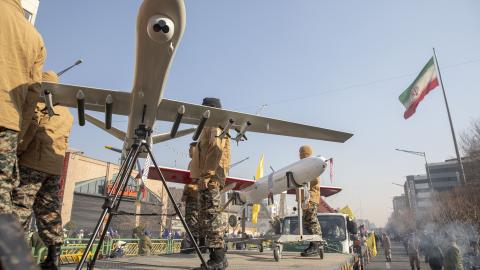
According to the Ukrainian Air Force, in the four years since Russia’s full-scale invasion, Kyiv’s air defense forces have intercepted more than 44,000 Shahed/Geran loitering munitions manufactured by either Russia or Iran. In that time Ukraine has also taken out more than 270 Iskander and KN-23 tactical ballistic missiles produced by Russia and North Korea. These numbers illustrate the major effects Russia’s deep-strike capabilities have had on the war. According to radar and space intelligence data, the Kyiv metropolitan area continues to be the most common target for Russian air and missile raids.
Ukraine continued to respond to Russia’s attacks forcefully. On February 22, Ukrainian long-range unmanned systems penetrated deep behind Russia’s front lines, with dozens of drones directed toward the Moscow metropolitan area. Russian authorities acknowledged that they intercepted more than 20 drones on approaches to the capital, where air defenses remained engaged for several hours.
The strike produced immediate effects. Underscoring the drone threat Moscow faces, civil aviation operations were temporarily halted at Moscow’s four major airports, Domodedovo, Sheremetyevo, Vnukovo, and Zhukovsky.
Ukrainian missile and artillery forces also extended their depth campaign into Russia’s strategic-industrial base. On the night of February 20, Ukraine used FP-5 Flamingo cruise missiles to strike the Votkinsk missile plant in the Udmurtia region some 1,500 miles inside Russia. Though battle damage assessments remain incomplete, open-source intelligence revealed a fire at the facility. Votkinsk is a core node in Russia’s strategic missile production pipeline, including for Iskander-M ballistic missiles and nuclear-capable intercontinental ballistic missiles (ICBMs).
In response, on February 23 Russia conducted a combined long-range strike using an Iskander-M ballistic missile and a large salvo of Shahed and Shahed-derivative unmanned systems. Moscow launched these attacks from multiple directions, including occupied Crimea and western regions of Russia. Ukrainian air defenses, aviation and electronic warfare units, and mobile fire groups intercepted the majority of the incoming drones. Though several impacts were reported, the strikes produced no operational-level effects. As it has throughout the war, Moscow continues to favor volume and saturation over precision.
On the ground, Russian forces sustained a mid-intensity offensive tempo, producing only limited territorial gains and slowly intensifying pressure on Ukraine. Open-source reporting indicated that Russia made limited tactical additions in several localized sectors. Pokrovsk, Lyman, Kostiantynivka, Rodynske, Kramatorsk, and the Kupiansk sector saw heavy fighting. Russian forces also moved into the settlement of Pokrovka in Sumy Oblast and advanced in the villages of Nykyforivka and Lypivka, as well as near Platonivka in Donetsk Oblast.
2. From Kursk to the Korean Peninsula, Pyongyang’s Military Continues to Evolve
As this report highlighted at the end of 2025, North Korean involvement in Ukraine was already expanding. Now, South Korean intelligence believes that approximately 11,000 North Korean personnel are stationed in Russia’s Kursk Oblast, a region that Ukrainian troops controlled in part for several months in 2024 and 2025.
According to intelligence reports, forces that Pyongyang has forward deployed to the region since 2024 have been quietly absorbed into Russian groupings, where access is tightly controlled and independent observation is limited.
Instead of remaining as discrete contingents, North Korean personnel have reportedly been assigned to specialized functions, such as artillery crews and reconnaissance drone teams. North Korean fighters on a second tour of duty have been assigned to train newer soldiers. Ukrainian President Volodymyr Zelenskyy has openly warned that this arrangement is allowing North Korean troops to gain critical knowledge of the dynamics of modern warfare, predominantly drone operations.
The bulk of the North Korean contingent operating in Russia originates from Pyongyang’s 11th Corps, an elite formation within the country’s special operations forces. Known as the storm troopers, the 11th Corps is designed to spearhead the opening of a second strategic front through infiltration, disruption, and deep-penetration operations.
These troops’ exposure to Russia’s war, therefore, carries consequences far beyond Ukraine. The deployment of North Korean forces has the potential to rewire the operational DNA of Pyongyang’s military. This development could accelerate the diffusion of modern combat practices into North Korea’s special operations ecosystem, laying the groundwork for a long-term security threat in East Asia.
3. What to Look for in the Coming Weeks
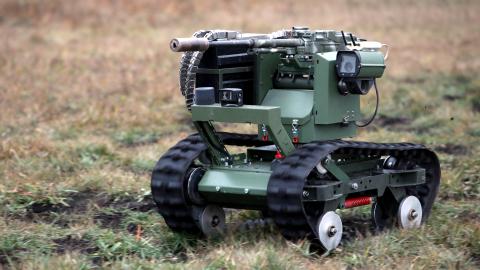
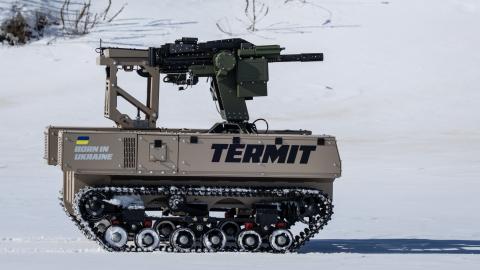
1. The Courrier UGV. This report is closely tracking Russian robotic warfare capabilities, of which the North Atlantic Treaty Organization is becoming increasingly aware. The Courrier unmanned ground vehicle (UGV) baseline warrants particular monitoring. Recent test visuals indicate the UGV has been equipped with new features, including 57mm rockets, equipment that enables river-crossing operations, and electronic warfare abilities. In the coming weeks, the Courrier baseline will likely see new combat roles.
2. North Korean troops on occupied Ukrainian soil. Given recent open-source indicators, it is increasingly plausible that North Korean troops could soon be operating in occupied Ukrainian territory in direct combat roles. Following Russia’s illegal annexations, Pyongyang now possesses a ready-made diplomatic pretext for such involvement: its participation can be framed not as expeditionary warfare, but as assistance on what Moscow claims is Russian soil. This legal fiction lowers the political threshold for deeper North Korean involvement and expands the scope for overt combat deployment.