










Executive Summary
- Battlefield assessment: The Russian military pressed hard for Pokrovsk and Kostiantynivka, while long-range strikes continued to shape a conflict that for years has been defined by a static battlefield geometry.
- Russian drone adaptations: With technological assistance from China and Iran, Russia began deploying a jet-powered derivative of a Shahed drone.
- Ukrainian forces in North Africa: Ukraine’s security services reportedly extended its extra-regional operations to Libya, where they targeted elements of Russia’s shadow fleet last week.
1. Battlefield Assessment
Combat activity across the battlespace remained heightened as the spring season sets in.
As this report warned in previous weeks, Kostiantynivka has emerged as a dangerously contested flashpoint. At times, tactical engagements near the city outnumbered those in the long-embattled Pokrovsk theater, one of the principal tactical focuses of the Russian invasion campaign. While Oleksandrivka, Kupiansk, Lyman, Pokrovsk, Orikhiv, and Huliaipole also experienced clashes last week, the overall battlefield geometry saw no strategic-scale changes.
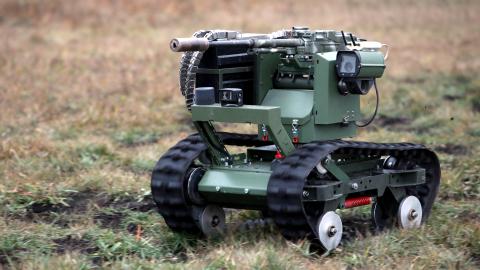
Notably, Russia’s Rubicon special drone-warfare unit continued its systematic targeting of the unmanned ground vehicles (UGVs) that the Ukrainian military increasingly employs for logistics and medical evacuations. Over the past year, the Rubicon unit has reportedly hit roughly 1,000 Ukrainian UGVs. In response, Ukraine’s Unmanned Systems Force has expanded operations beyond the front lines. On April 4, drones from Ukraine’s 414th “Magyar Birds” Brigade struck a radar system supporting Russia’s S-400 architecture in Crimea.
Long-range strikes continued to shape a significant portion of both sides’ concepts of operations (CONOPS). During the night of April 6, Ukrainian drones hit an oil terminal at the port of Novorossiysk. Additionally, on April 1 and 2, Ukrainian drones struck the Bashneft-Novoil refinery in Ufa, the capital of the Russian Republic of Bashkortostan. The attacks reportedly triggered a fire at the facility, located approximately 870 miles from the front lines. At the time of writing, battle damage assessments remained ongoing.
The strikes on the refinery in Ufa indicate that Ukraine is now waging a more deliberate campaign against Russia’s energy sustainment nodes and hubs rather than focusing solely on energy export infrastructure. Bashneft-Novoil is not just another refinery; it is a major producer of high-grade lubricants, including marine, hydraulic, and engine oils. The facility has an annual processing capacity of roughly seven million tons. These outputs are essential to sustaining Russia’s military kill chain, as engines, drivetrains, naval systems, and heavy equipment depend on the refinery at Ufa to function over time.
Russian forces, for their part, also continued to sustain a campaign targeting Ukraine’s energy infrastructure and population centers. For the second consecutive day, drones struck facilities tied to Naftogaz, Ukraine’s largest state-owned energy company. Overnight on April 4-5, Russian forces also struck a gas production site in Poltava Oblast that they had hit the previous day, signaling an intent to keep the facility offline. Another strike hit an oil and gas facility in Sumy Oblast, igniting a fire. Across Sumy Oblast, Russian drone attacks injured 36 people, including 19 children.
Finally, last week saw an unprecedented kill in the drone warfare segment of the conflict. Although independent verification and technical details remain limited, Ukrainian sources report claims that the Wild Hornets group used a STING interceptor drone, designed for counter–Shahed missions, to engage Shahed-type loitering munitions at distances reportedly up to 310 miles. According to these accounts, an operator from Ukraine’s Bulava unit, using the call sign “Hulk,” employed a technology called HORNET VISION Ctrl to conduct the remote engagement.
If confirmed, the incident would mark a significant extension of the interceptor-drones range and underscore the continued evolution of Ukraine’s layered defenses against unmanned aerial vehicles (UAVs).
2. A Rising Drone Warfare Threat from the Russia-Iran-China Partnership
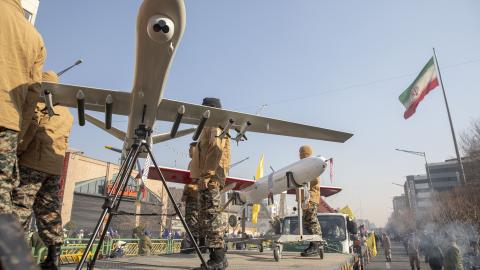
On April 5, Russian forces struck Kharkiv’s Shevchenkivskyi District with a jet-powered derivative of a Shahed drone. Initial reports indicate that the strike caused structural damage to multiple residential buildings.
In addition to showcasing Russia’s increasing use of faster loitering munitions, the strike underscores an evolving contest between drone-enabled offense and counter-drone defense. Ukraine’s interceptor-drone ecosystem has scaled rapidly, reportedly producing approximately 100,000 units in 2025 and accounting for the majority of Shahed kills in the opening months of 2026.
That success has driven Russian adaptation. Moscow is now fielding jet-powered drone variants likely derived from the Iranian Shahed-238 lineage. These systems trade lower cost efficiency for higher speed, compressing defender reaction times across the kill chain.
Ukrainian military intelligence has reverse-engineered at least one such intact system and published a technical assessment of its findings. The platform, powered by a Chinese Telefly JT80 turbojet engine, extends the drone’s range to roughly 621 miles and nearly doubles the speed of legacy Shahed drones. Russian operators exploit this performance envelope deliberately, accelerating through contested air-defense zones and during the terminal-dive phase of the munition to reduce the probability of interception.
3. Ukraine Reportedly Tackles Russian Shadow Fleet off Libyan Waters
According to an April 3 investigation by Radio France Internationale (RFI), Ukrainian personnel have reportedly expanded their operational footprint in western Libya, pointing to a widening proxy contest between Russia and Ukraine beyond the European theater and into Africa.
The report follows Russian allegations that Ukraine forces targeted the Arctic-Metagaz, a tanker associated with Russia’s shadow fleet, off Libya’s coast on March 3. Citing well-placed Libyan sources, RFI reports that several hundred Ukrainian personnel are now deployed across multiple sites in western Libya and are operating in coordination with authorities in Tripoli. The same report attributes the strike on the Arctic-Metagaz to Ukrainian naval drones, suggesting that Kyiv is projecting asymmetric maritime capabilities beyond the Black Sea and into the central Mediterranean.
Ukrainian personnel are also reportedly positioned at an air force academy in the Misrata, alongside a broader Western intelligence presence that includes personnel from several member states of the North Atlantic Treaty Organization (NATO). A second site near Zaouïa, adjacent to the Mellitah oil and gas complex, reportedly hosts a Ukrainian drone-launch facility with direct access to the Mediterranean.
While open-source intelligence has not confirmed the presence of a Ukrainian contingent in Libya, Kyiv has previously invested in extra-regional efforts to impose costs on Russia, most notably in Sudan. Moreover, imagery from the reported engagement off the Libyan coast appears to show Ukrainian unmanned naval robotic-warfare platforms, including remotely operated or autonomous vessels equipped with sensors and weapons.
Ukrainian military and intelligence services have already perfected these platforms in the Black Sea theater through operations against Russia’s Black Sea Fleet. Any effort to expand their use into North Africa would mark a notable escalation in Ukraine’s efforts to contest Russian logistics and influence far beyond the immediate battlefield.
4. What to Look for in the Coming Weeks:
Russia may opt to retaliate against the reported Ukrainian contingent in Libya. If so, Russian forces may target overseas-deployed Ukrainian personnel.
The next weeks will likely see an increase in drones attacking unmanned ground vehicles (UGVs) in Ukraine, as the Russian military pushes to stretch Ukrainian logistics flows to the front lines amid a rising operational tempo.