

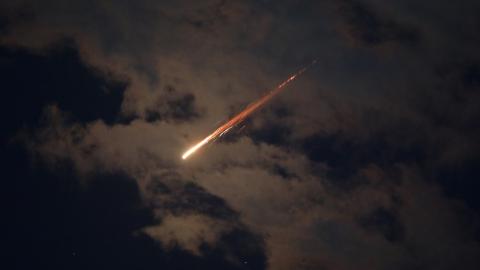

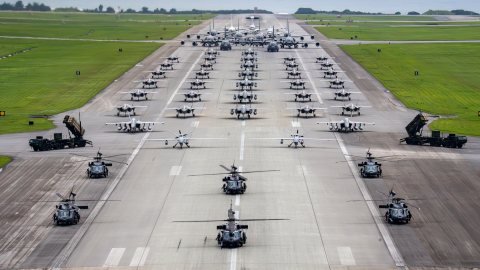








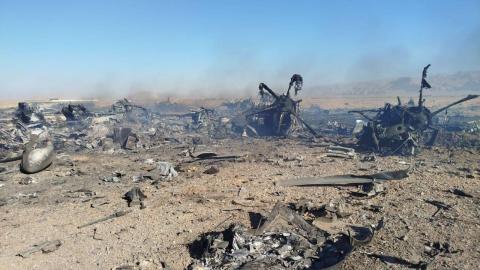
Last week’s Iranian strike against the Prince Sultan Air Base in Saudi Arabia which injured twelve Americans, damaged U.S. refueling aircraft, and destroyed an E-3 Sentry AWACS—a vital and rare command and control aircraft—is hard to ignore.
The lost aircraft is a crucial asset for situational awareness, battle management of forces, and early warning of inbound enemy assets, and one not so easily replaced.
Unsurprisingly, reports emerged quickly that Russian intelligence assisted Iran in the successful destruction of a precious U.S. asset.
Russia, still smarting from the loss of several of its own AWACS during its war against Ukraine (with a total operational fleet of only four to eight range left today) surely jumped at the chance to pluck out one of America’s “eyes in the sky.”
The E-3 destroyed was one of only sixteen remaining in the entire U.S. fleet—six of which were deployed to the theater in mid-February.
The lost aircraft cannot be immediately replaced, the final E-3 produced by Boeing was delivered in May 1992, when George H.W. Bush was still President and the original run of the sitcom Roseanne was the tops on TV.
The age of the fleet means that only some E-3’s are available at any one time.
Replacements, either the E-7 Wedgetail, a space-based alternative, or some combination of the two are still years away.
The loss is not only a black eye but and clear further evidence, if any more were needed, that Russia will not be deterred from using every means available to inflict pain on the U.S..
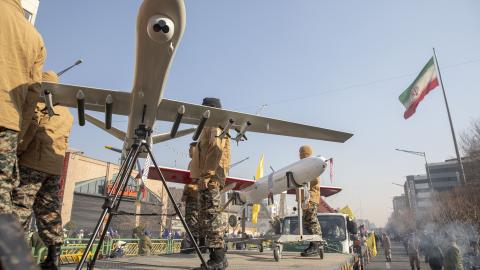
Just last week, intelligence reporting detailed Russian assistance to Iran in the form of drone deliveries, as well as “satellite imagery, targeting data and intelligence support.”
The more capabilities and money the U.S. burns against Iran, the less they can put into deterring Russian aggression against NATO or could sell to Europe for delivery to Ukraine.
While it has yet to happen, recent conversations around diversion of weapons meant for Ukraine to the Middle East, highlights the major implications of the war beyond the immediate theater, and indicates this thinking may be rational.
Better still for Russia, a protracted war against Iran will bolster isolationist voices in the U.S. and distract the Trump Administration from its ongoing efforts to forge peace in Ukraine.
Russia which has shown zero interest in ending the war must fort appearances sake feign interest in peace when the Trump Administration engages, lest its intransigence catalyze a shift in Washington to a more robust pressure campaign against Moscow.
Sensing an opportunity to drive a wedge between the U.S. and Europe and to advance its aims in Ukraine. Reportedly, Putin recently offered the U.S. a trade; stop sharing intelligence with Ukraine and we’ll stop sharing with Iran.
The Trump administration rejected the proposal, and the strike against Prince Sultan Air Base shortly thereafter was intended to send a message: “You should have taken the deal.”
Similarly, the fall of the regime in Tehran not only risks a new government friendlier to the West coming to power but would be surely viewed in Russia as potentially destabilizing domestically.
For all these reasons, Moscow has every interest in making sure U.S. aims in Iran are stymied and that U.S. operations in the region are as bloody and costly as possible.
We have seen this playbook before.
During allied operations in Afghanistan, Russia paid bounties to the Taliban for every U.S. or allied soldier in the international coalition or member of the Afghan National Defense and Security forces killed.
For the Kremlin, all roads lead back to Ukraine and Russia’s undiminished desire to take the whole country. The United States remains the chief roadblock in Putin’s mind to one day fulfilling that fantasy, Iran provides an excellent opportunity to drain U.S. energy, drive a transatlantic wedge between the U.S. and Europe, and stabilize a key ally in the authoritarian axis.
The recent loss of the E-3 sentry is message from Russia should be read loud and clear.
Putin wants a diminished America; assisting Iran is one way of pursuing that end.
Now it is high time the U.S. send Russia a message of its own: “We see what you are doing, and we will not let you get away with it.”