











Battlefield Assessment
The United States began Operation Epic Fury alongside Israel’s Operation Roaring Lion on February 28. By the end of the first week, the two allies had systematically dismantled the Islamic Republic’s military infrastructure and put serious pressure on Iran’s long-range strike salvos. Nonetheless, the Islamic Revolutionary Guards Corps (IRGC) is tightening its grip on the country’s political system. Gulf Arab states—and global energy markets—remain under growing stress. A systematic Iranian campaign targeting the region’s desalination plants looms as the most dangerous wildcard.
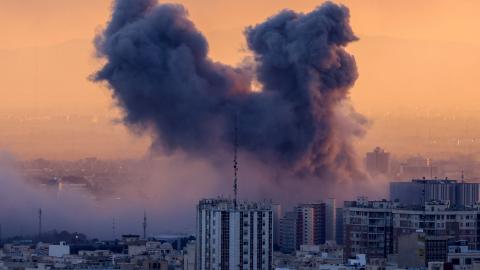
Over those first seven days alone, the US military reportedly struck more than 3,000 targets across Iran. As of the tenth day of the campaign, American forces have engaged some 5,000 targets, marking a hike in operational tempo. The US military has also hit more than 50 warships overall. Washington’s target set prioritized the elimination of the country’s missile launch capabilities and military facilities, as well as the command nodes tied to the Revolutionary Guards’ strategic weapons.
In parallel, the Israeli Air Force concentrated on degrading the Islamic Republic’s air deterrent. Israeli strikes targeted 10 of Iran’s 18 air bases, and cratered runways, destroyed hardened aircraft shelters, and reportedly damaged or eliminated several heavy-lift and combat aircraft.
The US military has reportedly shifted from a reliance on long-range, standoff weapons to stand-in precision-strike methods against Iranian targets. Rather than employing expensive cruise missiles and other standoff munitions with high price tags, American aircraft are now increasingly using Joint Direct Attack Munitions (JDAMs), which convert unguided bombs into precision weapons guided by inertial navigation and Global Positioning System (GPS) kits.
This transition likely reflects two operational dynamics. First, earlier phases of the US and Israeli campaigns capitalized on the 12-Day War’s success and heavily degraded what was left of Iran’s integrated air-defense network, allowing coalition aircraft to operate closer to their targets with reduced risk. Second, the shift in weaponry reflects cost considerations. Expert writings suggest that even the first 100 hours of Operation Epic Fury cost Washington $3.7 billion. High-end standoff weapons carry substantial unit costs, while JDAM kits provide a far cheaper precision-strike option that can be used once enemy air defenses have been sufficiently suppressed. In practical terms, the US campaign appears to be moving from its initial phase of standoff attacks to a more systematic destruction of Iran’s remaining critical military capabilities and defense technological and industrial base. This phase allows Washington to employ less expensive weapons while also maintaining the depth of its offensive magazine.
Israeli air operations reportedly targeted Tehran’s Mehrabad Airport, a key asset long associated with logistics networks supporting the IRGC and its regional proxies. According to Israeli military statements, the strike package targeting Mehrabad focused on aircraft that the IRGC Quds Force allegedly used to transport weapons to Hezbollah and other proxy militias across the region. Satellite imagery data appears to show extensive damage across the airfield. Visual analysis also indicates that at least 17 aircraft sustained damage there, while several platforms were reportedly destroyed.
The Israeli Defense Forces (IDF) indicated that their air campaign also targeted facilities that supported Iran’s missile production capacity in the Parchin and Shahrud areas, long associated with elements of the Islamic Republic’s strategic weapons manufacturing. Israel’s campaign increasingly targeted the regime’s security apparatus as well. In Isfahan, the IDF’s strikes hit installations charged with maintaining internal security and facilities operated by the Basij, a paramilitary militia branch within the IRGC. Facilities that Israel targeted included the headquarters of a regional corps command, an IRGC base, and a police command facility tied to the Revolutionary Guards. In other parts of Iran, Israeli forces targeted missile launch sites and rocket-engine production facilities.
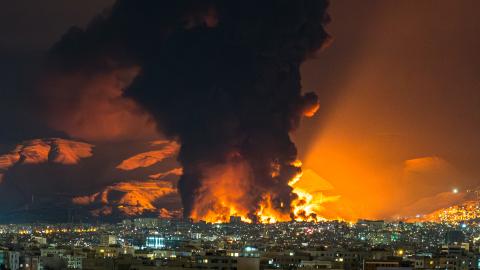
In a notable escalation, the joint US-Israeli campaign began striking elements of Iran’s oil infrastructure, including several fuel storage facilities and depots. This move suggests that the military-strategic planning behind the joint campaign has widened the pre-determined target sets in an effort to impose economic pressure on the Islamic Republic, while further constraining its war-sustaining capacity.
For its part, Iran continued to conduct missile and drone salvos, though at a declining combat-operations tempo. As of March 9, Iran had launched approximately 174 waves of missile and drone strikes against Israel since the outbreak of hostilities. Tehran directed most of these attacks toward central Israel, with the Tel Aviv metropolitan area absorbing more than half of incoming salvos.
Notably, the operational tempo of Iran’s long-range strike campaign has declined drastically. Between February 28 and March 9, the number of Iranian strike waves targeting Israel dropped roughly fourfold. Nonetheless, open-source intelligence suggests that the IRGC is employing ballistic missiles with “shotgun-type” warhead configurations in its strikes against Israel. These munitions, which carry payloads that disperse multiple fragments or sub-munitions during the terminal phase of flight, are designed to complicate interception efforts and stress air and missile defenses.
The systems involved likely derive from the family of Khorramshahr missiles, a core component of Iran’s long-range missile deterrent. The Khorramshahr lineage carries the same design philosophy as North Korea’s Musudan missile, reflecting decades of technical exchange between the Iranian and North Korean weapons development programs.
Among the Gulf Arab states, the United Arab Emirates (UAE) has absorbed the bulk of Iran’s missile and drone strikes. As of March 9, Tehran had targeted the UAE with 1,440 drones, eight cruise missiles, and 253 ballistic missiles. As of that same date, the UAE boasts a 90 percent interception rate against Iranian drones and missiles. The UAE Ministry of Defense has uploaded videos showcasing AH-64E Apache gunships preying on Shahed drones launched by Iran, mimicking a frequent concept of employment that Ukraine uses in its counter-drone operations.
As the last edition of this report detailed, US radar architecture in the region remained a high-priority target of the Iranian campaign. Visuals circulating across social media appear to indicate the suspected locations of AN/TPY-2 radar units, the principal sensor components supporting the Terminal High Altitude Area Defense (THAAD) missile-defense batteries the United States has deployed throughout the region.
These reports suggest that Washington had positioned its THAAD systems in the UAE and Jordan. Imagery emerging from the UAE, which is known to operate two THAAD batteries, shows visible structural damage and scorched equipment at locations previously associated with the radar installations. This evidence indicates that Iranian salvos may have struck the deployment site. Whether the radar arrays were destroyed or only damaged, however, remains unclear at this stage.
These strikes are notable, as the AN/TPY-2 radar is a particularly high-end sensor. Operating in the X-band frequency range commonly used for missile defense, it provides extremely high-resolution tracking that allows the system to distinguish between objects traveling along ballistic trajectories and differentiate actual warheads from debris or decoys.
The radar is particularly important because it combines precision with long-range surveillance capabilities enabled by its large phased-array antenna, high transmission ability, and advanced beam-steering technology. A deployed AN/TPY-2 installation includes a large antenna array together with supporting elements such as power generators, cooling equipment, and control electronics. Although technically transportable, it is difficult to conceal. Moreover, an operating radar emits signals that an adversary’s electronic sensors can detect and geolocate.
While the exact circumstances surrounding Iran’s strikes against the AN/TPY-2 remain unclear, there are several plausible explanations for them. The Iranian strikes notably coincide with indications that Russia has been providing Tehran with critical data transfers regarding American force deployments across the Middle East.
The precise scale of Moscow’s support for Tehran remains unclear. However, Iran’s own ability to monitor American military movements appears to have been weakened following recent US and Israeli strikes against Iranian command and control architecture. In this context, targeting information from Moscow could help restore some of the Revolutionary Guard’s operational capabilities.
Iran Intensifies Its Missile and Drone Campaign as Hardliners Shore Up Power
Iran’s missile and drone campaign has entered a more dangerous phase as the Islamic Republic expands the scope of its CONOPS (concept of operations) to target critical infrastructure across the Gulf.
Recent Iranian strikes have reportedly targeted Kuwait International Airport, locations across Riyadh, hydrocarbon-related infrastructure in Saudi Arabia’s Shaybah oil field, and high-value sites in the UAE and Bahrain. Beyond their immediate operational impact, these attacks—combined with simultaneous political developments inside Iran—suggest that the IRGC and other hardline factions are consolidating power.
Iran’s strikes contradicted earlier pledges by Masoud Pezeshkian, the country’s elected president, that Tehran would avoid attacking neighboring states. Prominent hawkish clerical and political figures inside Iran publicly criticized Pezeshkian for this statement. The decision to proceed with the salvos, therefore, highlights the state of play inside the Islamic Republic and underscores the dominant role the Revolutionary Guard holds in wartime decision-making.
Meanwhile, Mojtaba Khamenei, the son of Ayatollah Ali Khamanei, the former supreme leader killed in the early stages of Operation Epic Fury, was elevated to succeed his father. The election of the younger Khamenei appears to have been a hasty decision that bypassed deliberation among many Iranian elites. Mojtaba, widely regarded as closely aligned with the IRGC and other radical factions inside the country’s security apparatus, now occupies the most powerful office in the Islamic Republic’s political system.
After Mojtaba Khamenei’s selection as supreme leader, Iran’s security establishment quickly signaled its loyalty to the new cleric. The IRGC, the Ministry of Defense, the Defense Council, the IRGC Quds Force, and other services issued statements pledging their allegiance to Mojtaba. President Pezeshkian also promptly released a statement pledging his loyalty to the Islamic Republic’s leader.
Mojtaba’s elevation under wartime conditions signals that the Iranian regime is oriented toward confrontation and survival rather than compromise. His rise carries a personal dimension too, as several members of Mojtaba’s immediate family were reportedly killed in the US-Israeli strikes that eliminated his father.
In political systems shaped by patronage circles and personal loyalties, vendettas can reinforce extremist instincts rather than political moderation. Mojtaba’s combination of personal grievance and deep institutional ties with the Revolutionary Guard will likely harden Tehran’s decision-making in the coming phases of the conflict. This trend aligns with assessments in earlier editions of this report that Iran could end up a military dictatorship when current military operations cease.
Energy Markets Become a Battlespace
The economic and military logic of Iran’s long-range strike strategy became clearer this week.
IRGC leaders asserted that the energy infrastructure and hydrocarbon exporting capabilities of the Islamic Republic’s Gulf Arab neighbors are now key strike targets. Iranian General Ebrahim Jabari specified that regional energy sites are within Iran’s operational range. Many of these facilities do not possess hardened defenses and therefore remain vulnerable to Iran’s low-cost Shahed drones. Sustained attacks on these facilities would not require large missile salvos, and even limited disruption of the region’s energy infrastructure could have a major strategic impact on global energy markets.
Maritime data illuminate the potential consequences of Iran’s pressure strategy. Ship tracking shows a severe drop in tanker movements through the Strait of Hormuz since hostilities began. Lloyd’s List Intelligence data indicates that no tankers weighing over 10,000 deadweight tons have entered the Gulf westbound since March 3.
Energy markets have reacted sharply to this new reality. On March 9, oil prices briefly exceeded $119 a barrel, levels not seen since mid-2022. (The historical peak is about $147 a barrel, reached in 2008.)
The Strait of Hormuz, the only sea passage from the Gulf to the open ocean, is central to Iran’s strategy in the ongoing conflict. Roughly 20 million barrels of oil per day—one-fifth of global oil consumption—normally pass through the strait. Any attempts to bypass the strait via pipelines offer only limited relief. Saudi Arabia’s east–west pipeline can reroute up to 5 million barrels daily, while the UAE’s line to the Gulf of Oman typically carries 1.5 million and could reach 2 million in an emergency. Together, these routes make up for only part of the normal traffic through the Strait of Hormuz. If the current disruptions to global shipping stretch into weeks, the pressure on global markets will intensify.
Political developments inside Iran are also reinforcing market anxiety. The elevation of Mojtaba Khamenei to succeed his father as supreme leader signals that radical factions remain firmly in control in the country. Overall, the conflict, and the associated risks to global energy flows, may endure rather than quickly de-escalate.
The Hydro-strategic Dimensions of the Gulf Conflict
The current conflict is exposing a critical but often ignored vulnerability that many states in the region face: water security. As Operation Epic Fury continues into its second week, Iranian drones have revealed the fragility of the region’s desalination infrastructure.
Desalination plants are the backbone of efforts to supply water to the Gulf, one of the world’s most arid regions. About 90 percent of Kuwait’s drinking water comes from desalination, as does 86 percent of Oman’s and around 70 percent of Saudi Arabia’s. These critical plants convert seawater, primarily via reverse osmosis, to water that can be used for drinking, industry, tourism, and agriculture.
The region’s desalination infrastructure is extensive but concentrated. Member states of the Gulf Cooperation Council (GCC) possess nearly half of the world’s desalination capacity, yet their supply network remains highly centralized. Declassified intelligence assessments note that although hundreds of desalination plants exist across the region, more than 90 percent of the Gulf’s desalinated water output comes from only a few dozen major facilities at a small number of coastal sites. Such concentration marks a geopolitical vulnerability: damage to even a few of these plants could interrupt water production for millions of people.
Operationally, these facilities are also difficult to defend. Many components essential to their functioning—pumping stations, intake systems, and filtration units—are exposed and susceptible to drone or missile strikes. Disruption of key elements within the system could halt production entirely. Moreover, if major equipment is destroyed, restoring the plants could take months, while fully reconstructing them might require years in the absence of improved contingency planning.
On March 8, Bahraini officials reported that an Iranian drone had struck a desalination plant, sparking concern that the attack might be merely the beginning of a highly attritional trend. The strike also occurred in a sensitive area near Bahrain’s capital, Manama, where many US military personnel and their families reside. This area has seen repeated attacks since US and Israeli strikes on Iran began on February 28. Bahrain’s Interior Ministry accused Tehran of attacking civilian facilities.
In a prolonged conflict in the Gulf, water infrastructure, not oil, may emerge as the region’s most strategically sensitive resource.
Potential Exposure for the North Atlantic Treaty Organization
In a notable geographic escalation of the conflict, Iran launched another ballistic missile toward Türkiye, marking the second attempt to strike the territory of a North Atlantic Treaty Organization (NATO) member state since the war began. The projectile was intercepted by NATO-integrated air- and missile-defense systems before it reached its intended target.
The incident highlights the Revolutionary Guards’ apparent willingness to widen the battle space beyond the traditional area of operations for which US Central Command (CENTCOM) is responsible. The attempted strike also indicates Iran’s willingness to test the alliance’s defensive architecture on its southeast flank.
Although the interception of the Iranian projectile prevented it from causing any damage, the episode underscores a growing risk that the conflict could acquire a direct NATO dimension if further attacks on Turkish territory occur.
What to Monitor?
Over the next 72 hours, policymakers should monitor the following:
- Additional Iranian strikes on desalination infrastructure across the Gulf. The recent Iranian drone attack on a Bahraini desalination plant highlights the vulnerability of water systems that sustain millions of people in the region. Repeated attacks on similar facilities would signal that the Revolutionary Guards are deliberately shifting toward targeting the hydro-strategic backbone of the Gulf Arab states.
- Renewed Iranian attempts to strike Türkiye. Any further missile activity against NATO territory would add a direct alliance dimension to the conflict and risk expanding the war beyond the CENTCOM theater into the Euro-Atlantic security space.
- The operational status of the Strait of Hormuz and the persistence of tanker disruptions. Oil prices may fluctuate in response to any prolonged disruption in Gulf shipping. But sustained prices above recent thresholds would signal that Iranian pressure on energy markets is translating into structural shocks rather than temporary volatility.
- Further consolidation of power by the Revolutionary Guards. Indicators of this development could include the marginalization of civilian leadership, the expansion of IRGC wartime authority, and continued hardline policy decisions under the new supreme leadership. In the meantime, Israel and the US may also target Iran’s new supreme leader.