










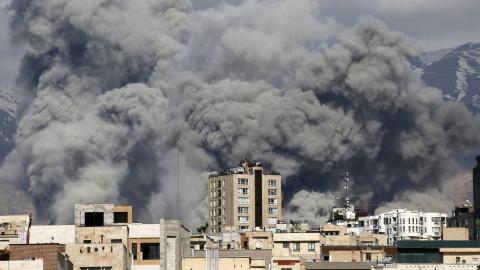
Below Can Kasapoğlu assesses the military situation in Iran as the United States and Israel conduct air strikes against the regime. He explains the current risks and challenges, as well as how decisions to spare key figures and institutions may reveal the allies’ intentions.
1. Khamenei Was Strategically Dead Long Before His Actual Death
Supreme Leader Ali Khamenei is dead, but he had been politically dead for some time. During the 12-Day War, the 86-year-old cleric was confined to hardened underground bunkers and no longer participated in routine wartime command. But make no mistake: Khamenei’s demise ushers in a new chapter for Iran. For nearly four decades, he centralized politico-religious authority over the state and society. In practice, his political grip surpassed his predecessor’s, Ayatollah Ruhollah Khomeini, who founded the 1979 revolution.
Yet over the past two decades, the Islamic Revolutionary Guard Corps (IRGC) evolved from a praetorian shield into the regime’s central nervous system. As Khamenei’s oversight of military affairs declined, the IRGC did not rely on real-time instructions from clerics to execute contingency plans. Decision pathways were embedded within the security apparatus, which could function under stress and heavy attrition. Iran, in practice, now resembles a military state dressed in theological garb. So the difference between Khamenei being alive in isolation or being dead under rubble may not prove militarily consequential. The IRGC has long been calling the shots.
2. The True Measure of Success Is How Swiftly the US and Israel Can Degrade Critical Capabilities and Kill Chains
The reported deaths of the IRGC Commander General Mohammad Pakpour, Defense Minister Aziz Nasirzadeh, and Senior Military Advisor Ali Shamkhani removed experienced nodes from Iran’s command network. Their decapitation disrupts coordination, imposes shock, and complicates succession. But the decisive metric is not who controls the military but whether the IRGC can sustain its capabilities and kill chains: Are the US and Israel destroying launchers faster than Iran can disperse them, sealing tunnel complexes with strikes, degrading drone production lines and storage depots, and reducing the Iranian salvo tempo in volume, accuracy, or synchronization? For dictatorships, replacing men is easier than rebuilding military infrastructure. Strategic success, therefore, lies in dismantling the machinery that sustains Tehran’s military operations.
For the US-Israel campaign to succeed, degrading the IRGC’s core capabilities—especially its missile and drone warfare architecture—is at least as important as eliminating leaders. During the 12-Day War, Iran launched approximately 500 ballistic missiles against Israeli population centers and military sites. That benchmark serves as a useful comparison, and early indicators suggest that the current operational tempo will drastically exceed the earlier pace.
The tempo and geographic spread of Iran’s attacks suggest that its operational kill chain remains intact. Tehran continues to conduct coordinated long-range salvos. These attacks span multiple theaters: American facilities in the region, Gulf Arab states, and Israel. After two days of war, the United Arab Emirates’ air defenses reportedly intercepted 152 ballistic missiles. On February 28 alone, Iran launched approximately 170 ballistic missiles at Israel. Hundreds of drones participated in these strikes.
Missile operations require pre-delegated authority, functioning logistics, secure communications, and disciplined execution. Launching a strategic weapon system into foreign territory is not comparable to firing an artillery battery against an enemy battalion. Missile warfare is a political-military act with regional consequences. The persistence of long-range strikes, therefore, signals continuity of command.
3. The Allies Need to Destroy Missiles and Launchers Quickly
The United States and Israel need to dismantle Iran’s missile and drone capacity before they deplete their interceptor inventories. Air defense systems are not infinite. Military commanders have to consider their stocks, reload cycles, and industrial capacity, which ultimately limit magazine depth.
During the 12-Day War, Israel employed its Arrow system and other layered defenses, and the United States reportedly engaged a substantial portion of the incoming threats with some 150 Terminal High Altitude Area Defense interceptors and approximately 80 Standard Missile-3 interceptors. Beforehand, the US used roughly 200 SM-2 and SM-6 interceptors to blunt missile and drone strikes coming from the IRGC’s Houthi proxies. Washington also employed an undisclosed number of Patriot interceptors in Qatar to protect Al-Udeid Air Base.
Therefore, from the outset of Operation Epic Fury, the allies have increased their operational tempo and sortie rates to destroy missiles and launchers before Tehran can use them. In the war’s opening phase, the Israeli Air Force appears to have mounted its largest air campaign ever, placing roughly 200 platforms in the air and striking more than 500 targets across the Islamic Republic.
Israeli sources indicate that 700 combat sorties in 36 hours reduced Iran’s stock of ballistic missile transporter-erector-launchers (TELs) by roughly half. This is significant, but it does not simplify the challenge ahead. For decades, Iran has built with North Korean assistance vast underground missile warfare complexes from which TELs can operate. So apart from the launchers, Operation Epic Fury needs to prioritize tunnel entrances linked to these hardened complexes.
4. Maritime Trade Faces Significant Threats
The Strait of Hormuz is once again at the center of geopolitical risk, and the military exchange has rattled maritime trade. After US and Israeli strikes on Iran, shipping vessels have halted or reversed Hormuz transits and abandoned tentative returns to the Suez Canal. Traffic is moving back to the Cape of Good Hope.
Roughly one-fifth of the global trade in oil and liquefied natural gas flows through Hormuz. Iran does not need to close the strait to exert pressure; it only needs to make transiting the waterway risky. Insurance rates spike before military conflict peaks, and freight rates react faster than fleets. If markets doubt the passage is safe, disruption is guaranteed.
5. How to Decipher the Allies’ Plans for the Day After
Analysts need to focus on what American and Israeli forces are not hitting. Target selection is strategic language, as is restraint. Washington and Israel may show their future plans for Iran by not striking certain political-military figures or institutions.
President Masoud Pezeshkian could be part of these plans. As an ethnic Azerbaijani Turk serving as the Islamic Republic’s president, his survival or removal is significant. Ali Larijani, who hails from the regime’s hardline establishment, is another important figure. In a postwar environment, figures like Larijani may become necessary to manage the IRGC’s global networks. Washington and its allies will likely prioritize stability over transforming Iran, so preventing terrorist attacks and managing escalation are probably their immediate objectives.
Beyond these political leaders, the status of the Artesh, Iran’s regular armed forces, is critical. This force is institutionally distinct from the IRGC. If its capabilities and command structure remain intact and are divorced from the guards, it could become critical in any postwar transition by serving as the backbone of the country’s new security forces.
6. What to Monitor in the Next 72 Hours
The next three days will be crucial in this latest war with Iran. In particular, analysts should monitor the following:
- The IRGC’s operational tempo in missile and drone salvos
- Senior political-military figures whom the United States and Israel spare
- The Iranian missile forces’ launcher density and survivability, reload intervals, mobility, and usage of underground facilities
- Any signs of defiance, fragmentation, or non-compliance within Artesh combat formations or among its senior commanders, as well as any drift between the IRGC and Artesh
- Tanker flows through the Strait of Hormuz, disruptions in automatic identification systems, and insurance spikes
- Any large-scale Hezbollah mobilization, which could indicate that Tehran intends to open a second front from Lebanon