













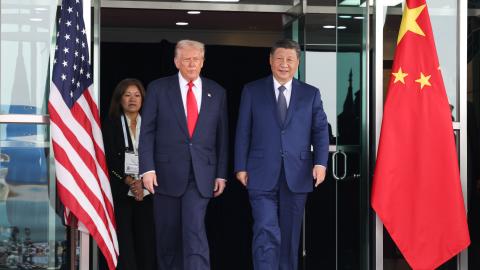
When U.S. President Donald Trump and China’s President Xi Jinping finally meet in mid-May in Beijing, the optics will be grand and the words may be noteworthy, but the outcome is unlikely to be earth-shattering. Idle speculation about a China-U.S. G-2 condominium or pronouncements that fundamentally alter the nature of the rivalry is largely baseless.
The trip, however, may offer a revealing window into the divergent strategic approaches of the two leaders. In that sense, Trump’s second highly choreographed reception in the Forbidden City may still mark a milestone in a bilateral competition that, at present, is trending in China’s direction.
Tactical Truce, Strategic Rivalry
Both leaders need the summit to reinforce their respective visions of strategic stability. For Trump, that means demonstrating strength on the global stage by projecting the United States as the one superpower capable of wielding both hard power and economic dynamism. For Xi, it means preserving sufficient global stability to keep China’s long-range development plans on track.
China has become a well-trodden destination for leaders in search of economic growth and strategic ballast. Consider the steady stream of visits over the past year. Australian Prime Minister Anthony Albanese made his second visit last July. Indian Prime Minister Narendra Modi met Xi in Tianjin last August, the first such meeting since the deadly 2020 border clash, underscoring that economics still compels a modicum of cooperation. French President Emmanuel Macron met Xi for the fourth time in China last December. South Korea’s Lee Jae-myung, Canada’s Mark Carney, and the United Kingdom’s Keir Starmer followed in January, with Germany’s Friedrich Merz arriving in February. The decks had been cleared for Trump’s visit at the end of March – until the Iran conflict forced a six-week delay.
There is no gainsaying that when the leaders of the world’s two largest economies and chief competitors meet, more is at stake than the bilateral relationship alone. Even if the broad contours of the summit’s outcomes can be anticipated, an unscripted element remains. Both leaders, while seeking a prolonged trade truce in the name of stability, are simultaneously competing for advantage. The likely reaffirmation of that truce will reflect tactical restraint, not strategic convergence, as both sides race to eliminate chokepoints and reduce dependence.
What ultimately matters is not the improvisational phrases Trump might utter or be maneuvered into by a meticulously prepared Xi, but the contrast between their strategic approaches. Trump’s approach, if not a fully formed strategy, remains episodic, transactional, and politically contested at home and abroad. Xi’s, by contrast, is comprehensive, institutionalized, and generational.
To understand that asymmetry, one must examine how Xi has reordered China’s priorities.
From Growth First to Security First
Xi has fundamentally inverted the reform-era hierarchy between development and security.
After 1949, Mao Zedong prioritized regime security and ideological control over economic growth. Deng Xiaoping reversed that hierarchy, elevating economic development as the central objective and adopting the posture later described as “hide your strength, bide your time” (韬光养晦). Growth became the foundation of national power.
Since 2012, Xi has restored national security as the organizing principle of governance. Economic modernization has not been abandoned, but it has been subordinated to a comprehensive national security strategy. Military-civil fusion, technological self-reliance, intelligentized warfare, regime control, and global rule-shaping are integrated into a single system designed to reinforce comprehensive national power.
Security is no longer a byproduct of policy. It is the framework within which all policy operates.
Xi institutionalized this shift early in his tenure.
The “China Dream” of national rejuvenation, announced in 2012, tied regime survival to long-term geopolitical restoration by 2049. The creation of the Central National Security Commission in 2013 centralized security authority. In 2014, Xi introduced the “Overall National Security Concept” (总体国家安全观), formalizing a holistic view of traditional and nontraditional security across political, military, economic, financial, technological, ecological, cyber, data, space, deep sea, polar, biological, and other domains.
The key word is “overall.” Security encompasses the full spectrum of state activity. It fuses ideology, industrial policy, military modernization, and technological ambition under one organizing principle within “Xi Jinping Thought.”
Industrial policy, therefore, became a national security policy. Initiatives such as Made in China 2025 were absorbed into this broader security architecture, linking advanced manufacturing, supply-chain control, and technological sovereignty directly to regime resilience and strategic competition.
Five-Year Plans as Strategic Blueprint
China’s Five-Year Plans chronicle Xi’s steady transition from prioritizing growth to prioritizing resilience.
The 13th Five-Year Plan (2016–2020) marked a decisive turn toward security-centric development. It accelerated indigenous innovation, focused on advanced manufacturing, and elevated strategic sectors such as semiconductors, aerospace, and quantum communications, as pillars of national power.
The 14th Five-Year Plan (2021–2025) formalized “dual circulation.” Domestic resilience became the anchor of development, reducing vulnerability to external pressure while selectively leveraging global markets. Technological self-reliance and supply-chain security were treated as strategic imperatives amid “changes unseen in a century.”
The 15th Five-Year Plan (2026–2030), which was officially approved in March, further consolidates this trajectory: securing development through security and promoting security through development. Reform means resilience-building rather than liberalization. Technology self-reliance and dominance provide security in China’s plan, while civil-military fusion allows industries to be less vulnerable to external threats and establish internal supply chains.
In doubling down on the pursuit of frontier technology as “new productive forces,” Xi has sought to leapfrog from intellectual property theft and emulating U.S. technology to owning the contest for wholly new innovations. One glaring example of this is Xi’s recent comment about China chasing real innovation by seeking a “zero to one” technology innovation strategy, versus simply copying or refining the technological creations of others. Ironically, the idea of “zero to one” is not original, but the title and concept of Peter Thiel and Blake Masters’ 2014 major best-selling business book, based on a Stanford University class on tech start-ups. Still, Xi undoubtedly eyes extending the “one” factor by increasing the volume of innovation, startups, and uniqueness while creating strategic advantages for Chinese technology.
Xi’s transitioning of China from fast-follower to true tech innovator has many motives. Xi is problem-solving at home, seeking to leapfrog the United States’ technological dominance, and creating end-to-end ecosystems that minimize foreign dependence. But underlying the whole systems approach is an innovative state that yields security dominance and not simply a stable, ever-growing economy.
Under Xi’s plan, China’s security and development integrations lead to a safer and more lethal China. The evidence for this is centered on China’s emphasis on AI-enabled intelligentized warfare as part of his reordered generational national project.
Primacy Before Conflict: Competing Theories of Victory
If development and security are fused, intelligentized warfare (智能化战争 ) cannot be understood in isolation. It is best seen as one component of a broader Chinese theory of victory.
One interpretation holds that China seeks to compress conflict into a machine-speed opening phase. Echoing concepts akin to “Hyperwar,” this model envisions AI-enabled “decision destruction” by paralyzing an adversary’s command networks, logistics, ISR, and political cohesion before a coalition can respond. In a Taiwan contingency, such an approach would aim to impose a rapid fait accompli. While still partly aspirational, this concept is no longer theoretical; elements of high-tempo, system-disrupting operations were demonstrated by U.S. forces in 2026. Beijing is clearly studying how the character of war is changing.
But this may be the less important interpretation.
A more compelling reading is that Beijing’s overriding objective is not to fight the United States, but to secure long-term economic and technological primacy. In this framing, AI-enabled military modernization serves primarily to fortify systemic resilience by sanctions-proofing supply chains, accelerating industrial upgrading, shaping global standards, and reinforcing cognitive influence.
Here, the capabilities of the People’s Liberation Army (PLA) function less as instruments of conquest than as strategic insurance. Intelligentized warfare deters intervention, compresses escalation timelines, and convinces adversaries that resistance would be prohibitively costly.
Official priorities reinforce this interpretation. At this year’s Two Sessions, PLA spokesperson Zhang Xiaogang outlined four focal efforts: integrating mechanization, informatization, and intelligentization; developing scalable, system-based “new-domain” forces; accelerating advanced weapons and defense innovation; and intensifying realistic training. These priorities are backed by sustained investment, including roughly 7 percent defense budget growth in 2026. The direction is unmistakable: build a system-of-systems military that integrates technology, industry, and operational doctrine.
PLA Daily describes intelligentized warfare as the next stage beyond informatization. It emphasizes AI-accelerated sensing, machine-assisted decision-making, system-destruction operations, and the integration of cyber, space, electronic warfare, and industrial capacity into a unified architecture. Computing power is treated as strategic infrastructure, and military-civil fusion ensures that advances in AI, quantum computing, and supercomputing flow directly into defense applications.
Yet this is not a story of decentralization. Communist Party control remains absolute. Xi has repeatedly reiterated the idea that “the party commands the gun.” Algorithmic acceleration coexists with political centralization; autonomous systems operate within tightly supervised authority structures. The objective is systemic superiority, not platform parity.
Recent internal disruptions, from far-reaching purges of senior PLA leadership to broader institutional tightening, raise questions about near-term readiness and timelines for a Taiwan contingency. They may delay operational confidence. But they do not alter the strategic trajectory. If anything, they reinforce Xi’s determination to ensure loyalty, discipline, and long-term control over a technologically transformed military.
The same logic extends beyond the military. The 15th Five-Year Plan, the “Safe China” campaign, and the dual circulation strategy all point in the same direction: resilience over efficiency, security over exposure, and control over liberalization.
This produces a central paradox. The more integrated, technologically advanced, and secure China becomes, the greater its capacity to wage high-speed conflict, and the stronger its incentive to avoid one that could jeopardize long-term primacy.
In this sense, intelligentized warfare is not simply about fighting wars faster. It is about shaping a strategic environment in which war becomes unnecessary.
Conclusion: Playing for Keeps
Winning without fighting may be the ideal, but what is truly at stake is the contest for pole position, not only in Asia, but globally. In that competition, Xi Jinping has reoriented China from growth-first pragmatism to security-first statecraft, fusing industrial policy, military modernization, and technological ambition into a generational project of systemic competition.
The central question is not whether China is preparing for war. It is whether intelligentized warfare is designed to fight and win one, or to deter intervention and secure primacy without fighting at all. The same ambiguity shadows China’s nuclear buildup. As Beijing continues a rapid buildup of its nuclear arsenal, is it simply seeking parity, or a shield for coercion, including a move on Taiwan?
As Trump and Xi prepare to meet, rhetoric about stability risks obscuring a harder truth. Beijing is not merely managing competition; it is methodically accumulating positional advantage. In Xi’s calculus, primacy may precede conflict, and intelligentized warfare may be the instrument that renders conflict unnecessary.
For both leaders, competition ultimately turns on the mobilization of internal resources. Each is buying time. But Beijing is using that time with strategic clarity: reducing exposure to external volatility, tightening control, and building strength through technological self-reliance.
Washington needs a comparably coherent approach. The United States must return to disciplined self-strengthening and capacity-building, aligning industrial policy, technology investment, and defense planning to compete over time. That requires easing the strain of war in the Middle East, and indeed of simultaneous conflicts abroad, and political fragmentation at home and refocusing on the foundations of national power.
On Taiwan, tactical restraint alone will not suffice. Strategic alignment demands strengthening deterrence alongside clarity of purpose. The United States should continue to anchor its position in the “One China Policy,” oppose unilateral changes to the status quo, reject coercion, and insist that cross-strait differences be resolved peacefully and with the assent of the people of Taiwan. Consistency is not passivity, but credibility.
When Trump and Xi meet, the likely outcome will not be resolution but reprieve. Both leaders will seek to manage competition, not end it. As Ryan Hass has noted, such periods of “strategic calm” are best used to strengthen national capacity.
In the end, despite their contrasting styles, the dealmaker and the strategist converge on the same imperative to accumulate leverage. The side that best aligns internal strength with external ambition will shape the balance of power and may determine the outcome of the competition without ever firing a shot.
Summits come and go; strategy endures.