











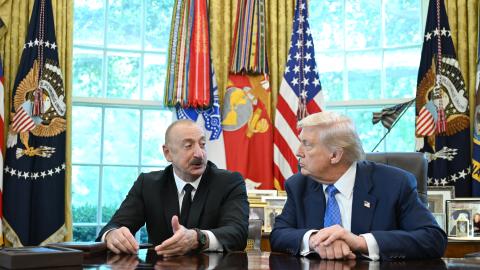
Representatives of the five Central Asian states — Kazakhstan, Uzbekistan, Kyrgyzstan, Tajikistan, and Turkmenistan — along with Azerbaijan, are expected in New York for the United Nations General Assembly in September.
Historically, meetings between the Central Asian states and the United States – the C5+1 – have taken place on the sidelines of the United Nations. It is the most natural and logistically efficient venue for President Donald Trump to re-engage with the C5 partners he hosted at the White House last November.
As of now, only foreign ministers are expected to attend the UNGA. But this could change if Trump extends an invitation to the leaders, according to a Central Asian diplomatic source.
This time, however, he has the opportunity to add Azerbaijan, transforming the format into a C6+1. Baku has already been invited to participate as a full member in Central Asian gatherings, and Washington should build on that momentum.
Azerbaijan is uniquely positioned: close to both Israel and Turkey – two of America’s most important regional partners – it sits astride one of the most important connectivity corridors linking Europe and Asia. Its inclusion would turn the C5+1 into a genuinely trans‑Caspian framework that reflects the emerging realities of Eurasian integration.
The move would also link two major diplomatic achievements of Trump’s second term: the launch of the Trump Route for International Peace and Prosperity (TRIPP), a 43-km strategic transit corridor connecting mainland Azerbaijan to its Nakhchivan exclave through Armenia, and Trump’s elevation of the C5+1 to a White House-level summit. While TRIPP was discussed at the C5+1 meeting in November, bringing Azerbaijan into the next gathering would allow the administration to present itself as the architect of a new Eurasian trade and energy map.
Strategically, a C6+1 format carries significant implications for great-power competition with China.
This is because Central Asia is so crucial to Beijing’s grand strategy. In its recently adopted 15th five-year plan, neighborhood diplomacy is listed as the top priority — ahead of relations with major powers or developing countries. Beijing seeks to build a “community with a shared future” with 17 neighboring states, including all five in Central Asia, to “create a favorable external environment” for national rejuvenation, as Foreign Minister Wang Yi has stated.
For China, Central Asia is a vital “hinterland” for energy and resource security, and a buffer against maritime disruptions.
The United States does not need to dominate the Eurasian Heartland or force Central Asian states to choose between Washington and Beijing. It simply needs to ensure that any Chinese westward access runs through a vast landmass of countries that maintain constructive relations with the United States.
A C6+1 format helps shape that environment without confrontation.
A stable Middle Corridor – the energy and trade route running through Central Asia, across the Caspian Sea and through Azerbaijan to Turkey and the Mediterranean – also benefits America’s energy-hungry allies in Asia, such as Japan and South Korea. Both increasingly look to Kazakhstan as an alternative oil supplier as they seek to reduce reliance on the Strait of Hormuz.
Several proposals have emerged for how to follow up on Trump’s engagement with the Central Asian leaders. At the November White House dinner, Uzbekistan’s President Shavkat Mirziyoyev suggested holding the next C5+1 summit in Samarkand, the ancient Silk Road hub, with Trump becoming the first sitting American leader to visit Central Asia. At a seminar in March, Kazakhstan’s Ambassador to the United States, Magzhan Ilyassov, proposed hosting the first C6 and United States Summit in his country’s capital, Astana.
Both would be historic. But a meeting on the sidelines of the U.N. in New York this September would be the true low-hanging fruit.
Furthermore, Kazakhstan, Uzbekistan, and Azerbaijan are all members of Trump’s Board of Peace for Gaza reconstruction and are willing partners of the American leader. Deepening engagement through a C6+1 format reinforces his “peace through connectivity” narrative and adds coherence to the Board of Peace’s purpose.
With Russia to the north, China to the east, and Iran, Afghanistan, Pakistan, and India to the south, the greater Central Asia region is emerging as the next frontline of great power competition – especially as countries seek alternatives to vulnerable maritime energy routes, a trend underscored by the severe disruption of shipping through the Strait of Hormuz.
By strengthening trans-Caspian links through a C6+1 framework and building on initiatives like TRIPP, the United States can help the region diversify its partnerships and reduce over-reliance on any single power, advancing stability through expanded economic options rather than confrontation.
The United States should use TRIPP as a springboard to pivot toward this critical region. A C6+1 summit at UNGA would be the simplest, most strategic way to begin. This is America leading through deals, not dominance — turning geography into opportunity.