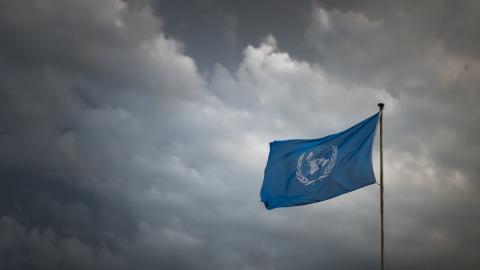
Caption
A flag of the United Nations flies at the United Nations Offices in Geneva on August 14, 2025. (Getty Images)
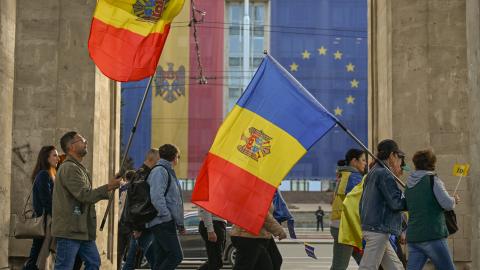
Russia’s war against Ukraine and Moscow’s constant meddling in Moldova’s internal affairs have only galvanized the Moldovan people’s commitment to a Euro-Atlantic path. In the country’s October elections, Moldovans reaffirmed this Western trajectory. Despite Russian interference, Moldova conducted free and fair elections, resulting in the formation of a pro-European government.
Since formally beginning European Union accession talks in December 2023, Moldova has made significant progress toward full membership. Notably, the country has become an important component of the European security landscape amid Russia’s ongoing war. Meanwhile, relations between the United States and Moldova have deepened in recent years. But much work remains.
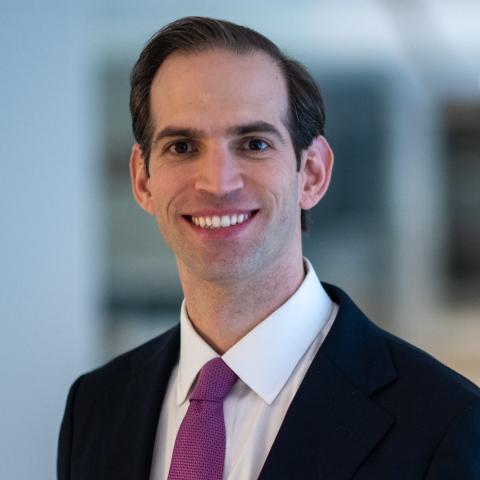
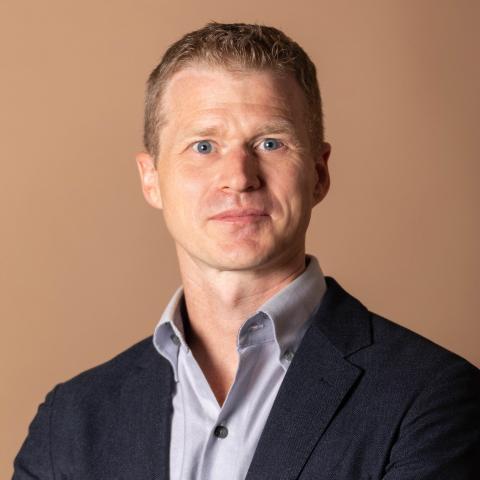
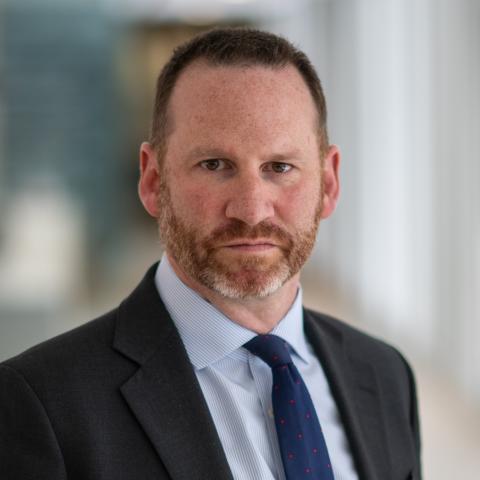
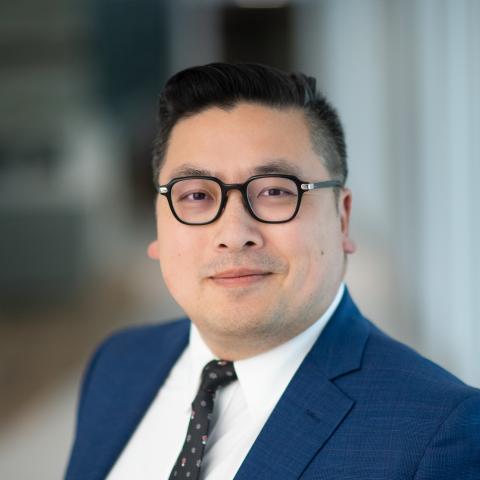
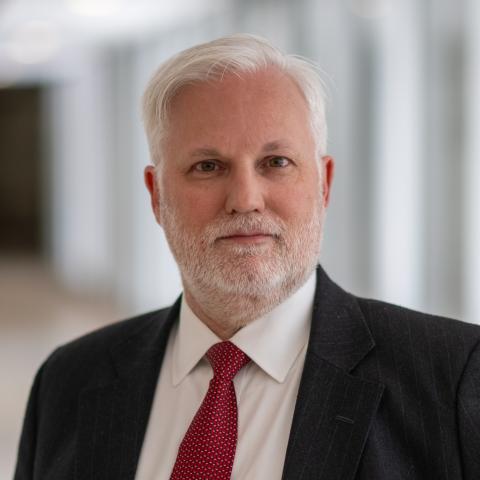
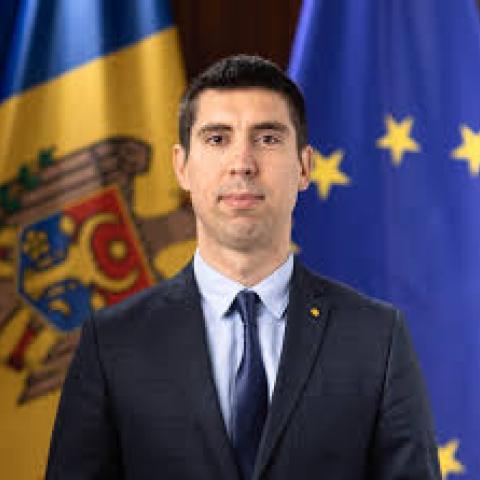
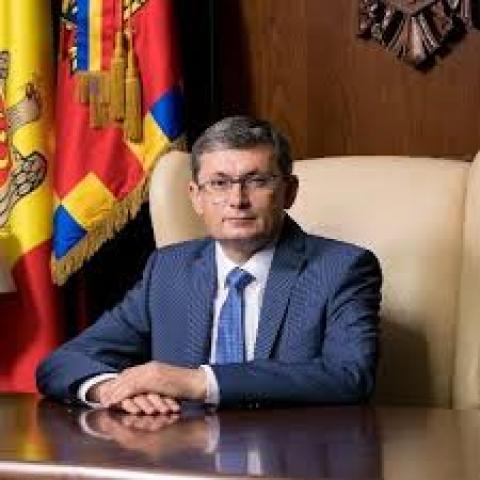
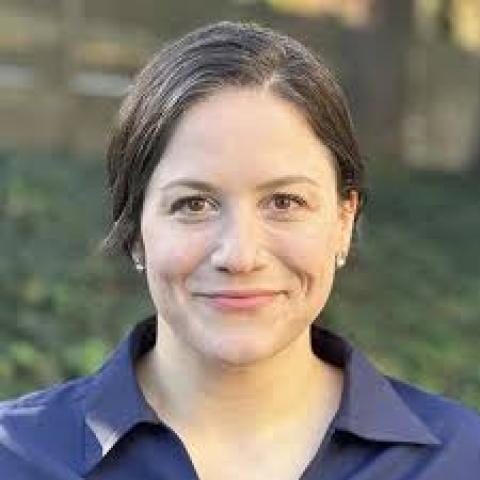
Hudson’s Luke Coffey will host Moldovan Deputy Prime Minister and Minister of Foreign Affairs Mihai Popșoi, Speaker of the Moldovan Parliament Igor Grosu, and Center for Strategic and International Studies Senior Associate Leah Kieff to examine the political, security, and geopolitical situation in Moldova and identify next steps.
Listen on Apple Podcast and Spotify.
Luke Coffey:
A big welcome to Hudson Institute, especially for our in-person guests who decided to brave through this winter storm we’re having here in Washington DC, this dusting of snow. I do appreciate you making it here in person. I want to thank our online viewers for tuning in for this important discussion entitled Moldova’s Euro-Atlantic Path, Regional Security, Energy Opportunity and Democratic Resilience.
Moldova is located right in the middle in the heart of Eastern Europe. And by definition, anything that is at the heart of something is important. And we know today the way, the geopolitical stakes are in your region, how important piece of the puzzle Moldova serves. The United States has been a strong supporter of Moldova’s sovereignty since the very beginning in the early 1990s. And we continue with economic cooperation, assistance with cybersecurity, limited but still important defense and security cooperation, but crucially with the North Carolina National Guard, which is the state partner for Moldova. And there’s a lot of work ahead on what the United States can do to work with our partners in Moldova and why it’s in America’s national interests to do so.
Now to discuss what is happening in the region in Moldova domestically, politically, what’s happening in the broader region to include, of course, the Black Sea and Ukraine and prospects for peace there in Moldova’s Euro-Atlantic journey towards the European Union, we have a fantastic panel. I’m very honored to introduce our speakers. I will ask each of them to speak for a few minutes with some opening thoughts. I’ll pose a few questions as the moderator and then we’ll open it up to the audience. I ask that when it gets to your turn to ask a question, identify yourself please with any relevant affiliation and ask a short question, not a long statement please.
Our first speaker will be the speaker of the Parliament of Moldova, Mr. Igor Grosu, who has served in this role since July of 2021. Our next speaker will be the Deputy Prime Minister and Foreign Minister of Moldova, Mr. Mihai Popșoi, who has been in this role since January of 2024. And then of course, last but certainly not least, my think-tank partner and colleague, Leah Kieff, who’s a senior fellow non-resident at CSIS. Leah has spent more than a decade working at some of the highest levels in the executive, working on complex and challenging issues and she’s now at CSIS part-time, but works in the private sector. And I should stress and point out that her remarks are in a personal capacity and don’t reflect the position of any organization with which she might be affiliated. But most importantly, to this conversation, Leah spent time in the Peace Corps in Moldova, and she saw firsthand on the ground what happens when a country like Russia tries to spread its malign influence.
So with that, welcome everyone. And Mr. Speaker, I will turn it over to you.
Igor Grosu:
Hello to everybody. I’m glad to come back to Washington. I remember we have had the same event last year. It’s become a tradition in December to come back to Washington.
Luke Coffey:
It’s a great tradition right up there with—
Igor Grosu:
Yes.
Luke Coffey:
Christmas and Hanukkah.
Igor Grosu:
We’re combining. Yeah.
So we’re here because we want to explain from the first source what’s happened in Moldova, especially now after a tough electoral campaign, parliamentary elections that took place in Moldova on 28 September. It was and it is a very tough exam for us because it took place in a very difficult environment, I mean from security environment, especially having our borders, Russian invasion in Ukraine with a huge pressure on our security, our economy, with a big number of Ukrainian refugees that are on our territory, more than 100,000, women kids. We will continue to provide them all needed assistance, access to education, social service, health, opportunities to find a job.
So in this environment with unprecedented pressure from the Kremlin and criminal groups and then the strategy to influence the electoral process in Moldova, I think we, despite all of this interference, we succeed to keep stability, first of all to keep peace in Moldova, which is very important for us and for our Ukrainian friends and to get a very good result in these elections. So we have 55 seats out of 101, a very powerful, clear mandate from our citizens in order to continue reforms, to continue our European integration process, and we will do this.
We’re here to explain to our partners here, to you, what are the next steps, to be sure that we can continue, and I’m sure that we can continue our common projects. One of the famous is one of the big investments in energy security electricity line, important one, a big investment of $130 million, Gutinaș-Strășeni, and we are very grateful for this despite the fact that our enemy was so, how to say, they expected that we will not come back to this project. We appreciate very much the United States’ decision to continue this project, a strategic one, not only for Moldova by the way, but for Romania, for Ukraine because this is critical energetic infrastructure for all countries in the region.
One of the priority will be economic development, which means that we will pay more attention to investments. Moldova will benefit from a huge package of financial support from the European Union, 1.9 billion Euro and we’ll do the best to use this package as an incentive for other investments, private investments and nevertheless to prepare our country for the moment when the peace will come and we, everybody hope, we hope that the peace will come in Ukraine and the process of restoration of Ukraine will start. So Moldova being the closest country to Ukraine, having the largest border, we will continue to invest in our critical infrastructure and will invite foreign companies, those who are interested in this big, big project to be part of it. This is shortly.
Once again, thank you for invitation. Thank you for opportunity to refresh our priorities. And of course, we count very much on your support in spreading information about the Republic of Moldova and sorry for lack of modesty, we can share our also experience, how to counter or how to discourage those who believe that they have the right to dictate to a small or big country how they should live, in what kind of society. This is our decision, our sovereign decision, democratic decision. And I’m saying every time we don’t ask and expect from someone from the east to be in love with us, no. We just ask to respect our internal decision. And if we decided democratically, transparently that we want to be a part of the world that lives in peace, European Union, this is our decision and we will continue to fight for this.
Luke Coffey:
Thank you. We respect Moldova’s sovereignty. There shouldn’t be too much to ask for.
Mr. Minister?
Mihai Popșoi:
Thank you. Hello, everyone. We come here as winners. We understand that it’s popular to be a winner in this town. We have managed to win despite the odds of this latest election, but it wasn’t easy by no means. The amount of interference and the amount of resources the Kremlin spent to undermine our democracy, to sabotage our sovereign choice has been remarkable, to the tone of several hundred million dollars. Just in one case, our law enforcement apprehended the keys to a crypto wallet with $107 million made available to pro-Russian parties, proxy parties in the Republic of Moldova. It hasn’t been easy, but we’ve managed to securitize our informational space, we’ve managed to defend our democracy from this avalanche of interference and the onslaught that we’ve faced.
And unlike last year, where we must admit we were less prepared and a bit too cavalier looking at the polls and seeing that we should win comfortably and we barely won last year, we learned those lessons and we were much more proactive, but also much more cautious in terms of making sure that we don’t allow for our democracy and our sovereignty to be taken away from us, given that the absolute majority of Moldovan people have decided that they want to turn the page on our Soviet past, on our post-Soviet recent past, and move firmly towards our European future and our future in the free world, as President Sandu likes to say. And yes, there have been attempts to sabotage this process, but Moldova resisted, which is a testament to the resilience of the Moldovan people, but also a testament to the incredible support that we’ve received from the international community, from the United States, from our European partners and beyond. And we are very happy to be in a position now to give back since we’ve been helped a lot to grow the resilience of our institutions and our society.
And we are eager to help our friends and partners so that they don’t have to face or rather that they are better prepared when they have to face some of the playbook that the Kremlin used against us. Although it’s a lot more resilient now than it was five, six years ago, we have diversified our energy supply. A few years ago, 100 percent dependent on Gazprom, now 0 percent dependence on Russian gas. We buy gas on the international market and sometimes it’s even cheaper than what we would’ve bought under the contract or rather most of the time it’s cheaper than what we would’ve bought under the contract with Gazprom because when you have total dependence on one provider, you have no bargaining power and you get to take the price that you are given and there are of course political strings attached that comes with it. When you buy in the international market from big traders, there is none of that.
We’ve made big strides in renewables. We’ve invested heavily without any state subsidy. It’s not because we didn’t want to give it, because we didn’t have the resources to provide the subsidy, but individuals in the private sector have invested heavily in renewables. And on one afternoon, admittedly, it was a Saturday at the end of August, we had 99 percent of consumption from domestic renewable sources of electricity in Moldova when a few years ago, we had 3 percent renewables. So they say that need is the mother of invention, we live by that.
And the fact that we’ve also been successful in securitizing our cyber infrastructure is nothing short of remarkable because a few years ago, we were virtually defenseless when it comes to the cyber domain. In the last few years, with the support of our partners in the US, in the UK, all over Europe, our Dutch friends have helped us cement our electoral infrastructure so that on election night, which was our biggest fear, the Kremlin will not be able to take over our infrastructure and fudge the numbers, and by the time we put them back, the legitimacy of the election can be thrown into question. That nightmare scenario has been avoided repeatedly. And I would like to believe that we have passed that threshold where we can be blackmailed and undermined.
But of course, we are not yet out of the woods. There are still challenges that we face, especially on the economic side. The last few years have been very tough. The aftermath, the repercussions of the Russian aggression against Ukraine, have really undermined our economic capabilities. But thanks to the 1.9 billion Euros from the European Union, thanks to the energy investment from the United States, and thanks to the commitment of the Moldovan society and the government, we are now moving full steam ahead and we are hoping that the peace in Ukraine will be a catalyst to economic growth. We are certainly availing ourselves very actively to help Ukraine in their reconstruction effort. Of course, all of us would like to see less destruction before that happens. And clearly, Ukrainians are the most interested in peace. Nobody wants peace more than the Ukrainians.
But there seems to be some pushback from the Russian side, but we have to commend the Trump administration for the effort, for the determination, and for the grit to stick with this process. It’s not easy, but to bring generational peace to Eastern Europe and to Europe is a significant contribution that is worth fighting for and worth putting the effort. We very much hope that peace comes sooner rather than later. And the most recent international sanctions seem to be a catalyst to that development. We certainly have benefited from the support of the international community to reduce the impunity that some of the fugitive oligarchs who have preyed on the misery that they’ve left behind in Moldova, that the international sanctions regime have really put them in a tough spot.
So we are thankful for the international community’s solidarity and the United States’ leadership in making sure that those that are preying on vulnerable folks and stealing, to the tune of 12 percent of GDP, the billion dollar fraud, which is mind-boggling to this day, but the fact that we managed to have the culprit or the main mastermind behind that fraud, the oligarch that was ruling Moldova with an iron fist before 2019 when we got rid of him, also with the strong participation of the United States, now to be in a position where that oligarch is facing the music and is undergoing due process in the Republic of Moldova is a strong vindication for the Moldovan people. And it’s also a strong indicator of how far we’ve come given in growing the resilience of our democratic institutions and our law enforcement institutions. And we cannot thank you enough and our partners in the United States and the European Union in helping us overcome the challenges.
And as the speaker mentioned, we are very happy and eager to give back to all of our friends who are facing the same playbook that we have faced. We’ve been helped quite a bit, and we are very eager to be able to be helpful to our friends and partners as well.
Luke Coffey:
Thank you, Minister Popșoi. Now over to you, Leah. We heard the view from the region. Now we get to hear the view from the analytical think-tank community here in Washington, which as a fellow think-tanker, I know it can often be very boring. But with Leah, it’s going to be very informative, I promise you, because she’s one of my go-to sources when it comes to all things Moldova.
So please, over to you.
Leah Kieff:
Well, thanks for hosting this conversation today. Obviously, you’ve managed expectations well, as I said before. So I’m going to try to touch in my opening remarks on Russia’s ongoing aggression in Moldova, its disruptive impact, and the likelihood of it continuing, as well as the current hopeful future for the Moldovan region of Transnistria.
So malign Russian activity in Moldova is not new, but it’s increased really markedly since Russia’s 2022 invasion of Ukraine. So Moscow’s spending on these disruptions are estimated at $50 million for 2023, $200 million for 2024, and $400 million for 2025, and that’s just the money that can be tracked. So what did this buy? So it’s bought activity, including massive vote buying schemes, as well as large cash offers for Moldovan citizens who are willing to engage in physical disruption. And these cash offers are in addition to the Moldovan citizens who traveled to Serbia to allegedly participate in a training camp on inciting riots, fighting law enforcement, and even using drones to drop explosives. And while much of this activity has been around elections, it hasn’t all been. Russia spent a lot of money in Moldova. We could spend the full hour we have here today just talking about that, but I want to talk about what’s been the impact of all of this disruption.
On a macro level, the continuation of these activities provides Moscow a testing ground for tactics to be used elsewhere, not just in election disruption, but also in ways to move illicit money into countries for illegal purposes. Within Moldova, the impact wasn’t sufficient to change the results of either last year’s Presidential or this year’s parliamentary elections, but that’s likely due to the Moldovan’s government’s ability to disrupt these efforts. But as we know, any law enforcement activity on that scale eats up a lot of resources. Those are resources that aren’t available for other priorities. And just for context, that 400 million that Moscow spent in Moldova this year is equivalent to about eight percent of the Moldovan government’s expenditures for this year.
This kind of disruption it also makes citizens feel less safe. They’re worried if there’s going to be violent riots before, during, or after their elections. So, while it hasn’t yet been sufficient to change the outcome of an election, the multidimensional campaign draws Moldovan resources away from important priorities and creates uncertainty for Moldovan citizens and potential investors in the country. These outcomes also fuel narratives, which are generated and amplified about the current pro-Western ruling party’s lack of progress on policy priorities, including whether they’re the right choice to keep Moldovan citizens safe. But the results of these elections also mean that the Moldovan people believe that a continued pathway towards the West is in their country’s interest. That’s not something that Moscow views as in its interest, so we should expect to see this disruptive activity continue. And in the face of this, it’s really important to continue to strengthen Moldova’s resiliency.
I would suggest a focus on law enforcement capabilities, especially on the border, to ensure that mercenaries and arms can’t pass through the country, but also in developing skills and tools to curb the flows of illegal funds. This has to be coupled with a judicial system that can hold people to account and that the Moldovan people believe is free and fair. And of course, as mentioned, continuing the focus on Moldova’s cyber development, including the collaboration between North Carolina’s National Guard and Moldova, is really important. These are all opportunities for Moldova to continue to use the ongoing Russian aggression towards its rapid development of structures and institutions. And recent Russian actions in Moldova have presented another really key opportunity for progress. This one around the previously frozen conflict in Transnistria. The Moldovan region of Transnistria had been locked in a frozen conflict since 1992. This region, which is largely Russian speaking and still hosts Russian troops and a large weapons depot, has long had a de facto government that’s friendly towards Moscow.
But a part of this friendship was Russia’s provision of free gas to the region. But in January of this year, Russia cut off their free gas to Transnistria. This January shutoff led to a really difficult winter in Moldova. It didn’t only leave Transnistrian residents with rolling blackouts, it also left the rest of Moldova with greatly increased costs of electricity. This is another example of Russia manufacturing a crisis, then coupling it with propaganda, in this instance, pushing the entirety of the blame for the situation itself and the suffering of Transnistria’s residents onto the pro-Western government in Chișinău. But Chișinău and the EU stepped in to support the people living in the Transnistrian region, which has opened new avenues for collaboration between Brussels, Chișinău and Tiraspol. And while the pathway for full reintegration is still a long one, for the first time in over 30 years, there’s light, which is a good thing for the Moldovans living in Transnistria, the country’s EU trajectory and the region’s security.
This process should continue with Moldovan departments and agencies creating plans for their respective spaces to integrate Transnistrian government structures and residents. The EU and the US should continue supporting Chișinău and Tiraspol as they reach an agreement that addresses state-owned enterprises in debts and ensures freedom of speech in press. The US might be particularly well positioned to help in negotiations around the Russian troop presence and weapons depot in the Transnistrian region. This historic opportunity cannot be missed and has to be accomplished in the next three years, and this progress is an important way for Moldova to continue to build on the momentum of their trajectory over the past several years.
But the progress that Moldova’s made thus far, as the other folks on the panel mentioned, hasn’t been done alone. Moldova’s partners and allies have helped immeasurably, including the US and the continuation of Moldova’s current trajectory matters to the US, not simply for their geographic location next to Ukraine and Romania’s eastern border, which is a vulnerable and important strategic location for the NATO alliance, but also because an economically successful and democratic Moldova benefits a stable Europe and the alternative would be a success for revisionism.
The US and Europe can learn from the example of Moldova about the importance of ensuring that foreign powers cannot inject money into elections and that citizens must believe their democracies will continue to deliver on security, rule of law, prosperity, and the basics of the social contract. That when these elements are present, free societies can repel even very well-funded foreign malign influence.
Luke Coffey:
Thanks. That’s a great overview, Leah. Thank you for that.
Mr. Speaker, I’d like to turn to you first with the first question. You mentioned that Moldova has gained a lot of experience and expertise at conducting free and fair elections in a difficult environment, countering malign outside influence, like from Russia. Are you, personally or through the parliament or with civil society, are you working with any other countries around the world to share what you’ve learned to help them make their own electoral systems, societies more resilient?
Igor Grosu:
Well, first of all, thank you for . . . We’ll take your notes.
Luke Coffey:
I told you.
Igor Grosu:
Because it was pointed out very . . . Yeah, exactly the situation in Republic of Moldova. Coming back to your question, of course, the nearest example, our neighbors, Romania. Yeah, I’m sure you know we have the same language, the same history, the same religious and so on and so on. Yeah, many, many . . . We’re calling between us brothers. So what we saw, according to our observation, those tactics or malign interference that was applied on the Moldavian soil, it was a kind of test with projection to Romania because they are trying to explore the same, how to say, cleavages or . . .
Leah Kieff:
Cracks.
Igor Grosu:
Huh?
Leah Kieff:
Like cracks in the . . .
Igor Grosu:
Cracks, yeah. For example, the name of language who was the first, who appeared the first, this one or that one, the religious sensitivities. So that’s why we must not only to share, but to learn from each other’s experience, how to deal with implication of social media in campaign. Yes, these tools, these platforms is the greatest tool to communicate between people to share knowledge, to share experience, to know other culture and so on and so on. But fortunately, unfortunately, the autocratic regimes are using very cynically these tools to spread the, to make more division, vice versa to help. So we must discuss how to secure our information space, how to, at the moment, come with regulations in some situations because if, for example, speaking about the money, 400 million euro, maybe for United States it’s modest.
Luke Coffey:
I still think it’s a lot.
Igor Grosu:
A lot, okay. For us, for a country as Moldova with 2.4 million citizens, it’s a tsunami. Yeah. Imagine if they, to allow them to . . . How big could be the risk to allow these crooks, these bandits, KGB agents to deploy all this finance to implement this strategy. It’s a catastrophic impact, not only in Moldova, in each small countries like Moldova. So that’s why yes, we have to learn. We have to learn. And from these elections, I’ve got big experience. From one side, you have to invest in your institutions, especially those who are responsible for security, for border, for police officers, prosecutors, yeah. Otherwise, if they are not enough equipped, motivated, publicly if they don’t see the support from the citizens, it’s hard to expect from them that they’ll do the best. And citizens where you have, all of us have to communicate to citizens to say not only nice things about how we are powerful and we are doing everything and so on and so on. No, if there is some risk, you have to communicate quickly and to explain how to protect, how to communicate.
And I think we succeeded in these two, how to say, objectives. From one side, we succeeded to motivate institutions. And I can say this because we can compare with some institution behavior in 2024, it was a little bit relaxed and not contributed enough to the common goal. Now, everybody, all institutions was in line and they give their contribution, did their job and citizens. And I’ll give an example. When the first time the police officer called me, and it was an incident in a village. I called him to ask what’s happened there. And he told me, “Look, it’s the first time when the people not only call police saying look, it’s something wrong or difficult or dangerous has happened there, no, the citizens come and help police officer to manage the situation.” We saw this, how to say, civic engagement. And the police officer was brave and satisfied that look, usually they are remaining alone with the problem and with those who broke the law.
But now we saw this civic engagement of the citizens, of Moldovan citizens, despite the language, despite the differences because when it’s come to the war or peace, the people have the choice between Russian model, which we can see it in Ukraine how worse it is, and model of peace, of prosperity, which again is very close to us, European Union. And the closest example is Romania, the closest border. So we are open to share it and we are doing this and we must be in touch because fortunately the crooks, Russia, Kremlin, they are also learning by doing.
Luke Coffey:
Yeah, absolutely.
Igor Grosu:
We have to do the same.
Luke Coffey:
And of course, God willing, when there’s a fair and just peace for Ukraine and they’re able to lift martial law and they have their next round of national elections, they’re going to face many of the same problems that Moldova has been facing in recent years, so they may benefit from hearing from your experience.
Also, just one observation or recommendation, for what it’s worth, probably not very much, you should consider establishing a Center of Excellence to formalize and institutionalize these lessons learned. A lot of countries in Europe have these centers of excellence focusing on different issues. Estonia has the cybersecurity one. That’s NATO affiliated though, but Finland has a Hybrid Warfare Center of Excellence, which was outside of the NATO framework even before they joined the alliance. So you should maybe consider a way to formalize your process of sharing these experiences.
Minister, over to you. My next question is about Ukraine. You rightfully observe that nobody wants peace more than the Ukrainians. I think this is clear by President Zelensky’s actions. He is now the main enabler for peace, while President Putin remains the primary obstacle to peace. But I suspect, or I don’t suspect, I know that Moldovans also want peace in Ukraine because it’s not well understood in Washington policy circles, but your destiny, your fate, your security is linked to Ukraine. If Ukraine falls, if Ukraine is captured by Russia, then Moldova has very serious existential problems. So, what is your take on the current peace process? And assuming or hoping that let’s say there is a ceasefire, there is a peace deal, what role can Moldova play in that process?
Mihai Popșoi:
Well, certainly our main focus is to be able to help Ukraine with the reconstruction effort. Our infrastructure will be made available, like we did when the Black Sea was blocked and Ukraine needed help to export grain through the grain corridor; we provided all the support. In this case, of course, we would prefer peace to come sooner rather than later because there is just so much senseless killing and so much destruction and it’s almost four years now, it’s mind-boggling. But at the same time, it’s incredibly powerful to see Ukraine resist far beyond what some expected, even some well-meaning friends. Ukraine clearly defends us. It’s not at all abstracts for us.
Some of our friends further in the West, when they say that Ukraine defends them, yeah, it might be true in somewhat of a more abstract way. For us, it’s very tangible. We have Russian drones across our airspace and fall on Moldovan soil with a somewhat dangerous regularity now. Some Russian rockets have violated our airspace and God forbid, if Ukraine were not to be able to resist like it has done heroically, thanks to the armed men and women of Ukraine and the Ukrainian society and the support of the international community, then we are back to that theory from the Soviet times of the domino effect cause the dominoes will start falling and the Republic of Moldova is clearly the first domino in that list. Odessa is nearby and no matter our investments in defense, of course, we would not be able to match the capabilities of the Kremlin.
But then of course, other countries in the region are also very much concerned, and that is diplomatically speaking. That’s why we see this incredible investment in defense from our Polish friends, from our Baltic friends, the investments in defense that Romania has made lately, but quite frankly, the entire Europe. And it’s no secret to anybody that Putin’s goal is to rebuild the Soviet Union and Ukraine is just a primary target in that sense. So it is in everybody’s interest, clearly in our interest, but it’s also in the interest of the free world, broadly speaking, and in the United States in particular, to make sure that the evil empire, as it was colloquially known, and not a lot has changed sadly, doesn’t get rebuilt because that would pose significant challenges to all those that love and cherish freedom, democracy, rule of law.
And they say that hope is not a great strategy, but in Moldova more often than not, we have to rely on hope and it has somehow worked out so far. We don’t want to jinx it, but so far things have resisted the worst prognosis, and Ukraine is certainly a remarkable case of resistance. And the Ukrainian society has proven that when you are fighting to defend your homeland, to defend your community, the disparity of the power asymmetry can be mitigated and is very much effectively mitigated in Ukraine, but of course, with incredible support from the international community. And we commend the Trump administration for its leadership. And again, we hope that peace will return to Ukraine and it will be truly generational peace in Europe.
Luke Coffey:
Yeah. Thank you for that. Now, if you have a question in your mind, get ready to catch my eye, but before we do that, I see Dan right there ready to go. Before we do that, I’m going to go to Leah. From a US point of view, what more should we be doing? What should we be doing differently? What can Congress do? What can the executive do? Just general thoughts about recommendations on what the US can do, because it is in our interest. It’s not charitable work, it’s required for our wellbeing. I often like to point out Europe is so economically vital to us. 46 out of 50 states export more to Europe than they do to China. Four trillion US dollars a year come into the US from Europe in terms of foreign investment. And if you have Eastern Europe that’s not secure and safe and you don’t have a Europe that’s stable, then that impacts the American worker. So it is in our interest that we help Moldova.
So Leah, I was wondering what you could offer.
Leah Kieff:
Yeah. So I think it’s been mentioned up here, but the US investment in the energy power line that happened recently, right in advance of the recent parliamentary elections, is a great example of how that model can work. Yes, it was an investment by the US government, but it’s an investment where US companies and businesses and technology are going to come in and execute on a lot of that work. So I think that that’s a way. It’s been mentioned or sort of touched on the Ukrainian reconstruction. I think that provides a really key opportunity for the US to be invested in Moldova and also be helping the pathway there or potential investments that the US and the US government may have, interests in Ukraine at some future date. Whether that’s with critical minerals or something else, Moldova would be a really natural pathway to move those things out of Ukraine and to process them.
I also mentioned Transnistria and the situation there. I think hopefully, as we’ve said sooner rather than later, peace comes to Ukraine, it presents a natural opportunity for the US and Europe as they’re having conversations with Russia about a variety of things, including removing some of these sanctions to remove the Russian troops from Transnistria. The US has obviously a long history of information sharing with Moldova. I think that’s a keyway that they can continue to support, but obviously those are just some of the things that the US can continue to do.
Luke Coffey:
So, you mentioned, if I understood you correctly, sort of linking the issue in Transnistria as part of the larger discussions with Russia and Ukraine. Is that . . .
Leah Kieff:
Gosh.
Luke Coffey:
Which I think—
Leah Kieff:
I don’t know that I would go that far, but look, I think the US is obviously at the table having conversations with Russia. That’s not something the Europeans are currently doing. But the fact that we’re at the table having those conversations-
Luke Coffey:
We might as well bring it up.
Leah Kieff:
. . . presents an opportunity separate and apart from these issues to have other conversations, right? So much of diplomacy is that person-to-person relationship, not just what’s being discussed at the table at that moment.
Luke Coffey:
Well, I hope President Trump is watching because he likes to make deals and he has a list of conflicts that he has resolved. So this could be another . . .
We have a microphone somewhere, I believe. Yep, the gentleman in the back has a microphone. So if you could please raise your hand. We’ll go to the gentleman in the front here first. If you could please state your name and any relevant . . . Dan, any affiliation, that’d be great.
Dan Whitman:
What an honor. Thanks, Luke, and welcome to the delegation. I’m Dan Whitman. I volunteer with a brand new think-tank called Delphi Global Research Center, and I’m also with George Washington University. Your outstanding Ambassador Kulminski, has been educating us incredibly effectively. He’s been here only three months, and he’s been doing an incredible job. At a public meeting last month, he spoke more about Transnistria than we’ve heard today. And if I understood, some of the ports of entry, or one of them has succeeded in limiting Russians from resupplying their own people in Transnistria. Kaliningrad is surrounded by the European Union. And if I understand, they have also acted to limit some of the ground entries, which makes it much more difficult. Is there any parallel between what Moldova is doing in Transnistria and what the EU is doing in Kaliningrad?
Luke Coffey:
Anyone want to . . . I would just say immediate observation would be one is territory that’s under control of Russia that belongs to a sovereign state and the Kaliningrad, of course, is I think universally accepted as an exclave of Russia, but there’s certainly parallels in terms of restricting flow.
Anyone want to discuss?
Mihai Popșoi:
Well, I would mention that it is true that since the Russian accession of Crimea since 2014, the Russian illegal military presence in the Transnistrian region of the Republic of Moldova was no longer subject to rotation. The parallel with Kaliningrad, I’m not sure how viable it is, but we are certainly no longer allowing. And it was unfortunate that it was allowed in the ‘90s and 2000s, both by Moldova and the fact that that has changed is important and is conducive towards a peaceful reintegration of the region. And this is the only option that we entertain, especially in light of the fact that from an economic standpoint, we are one country. When they are doing exports, we are one country. But when it comes to politics, they say that that’s no longer the case, which I find a bit ironic.
But the fact that 80 percent of everything that is produced in the Transnistrian region of the Republic of Moldova is sold on the European market and the rest of the Republic of Moldova only 70 percent tells you that the region is even more anchored into the European market than the rest of the country, which is a good thing. But we need to make sure that we have a level playing field. And like we introduced last year, the custom stacks for the first time in over 30 years, we’ll need to prepare the ground and discuss with the folks on the Left Bank and engage proactively in economic reintegration and political reintegration we have to follow, but it needs to be done responsibly step-by-step so that we take into account the biggest elephant in the room, the Russian military presence that needs to be addressed before we can engage in any meaningful discussions on that agenda. But also the cost of reintegration that also needs to be taken into account. And we are starting now these discussions about how we fundraise in order to be able to afford the cost of reintegration.
But Moldovans are clearly the most interested in reintegration because our EU accession and reintegration are two important tracks. And certainly, given the fact that in the past 33 years, we’ve been able to maintain peace and stability on the Nistru, and especially in the last four years, is very important achievement and we wouldn’t take it lightly. And our key priority now is to maintain peace and stability and not create any circumstances in which it could lead to any sort of escalation. Our primary focus is to maintain peace and to have a responsible approach via economic means to reintegrate the region.
Luke Coffey:
Thank you. The gentleman in the black sweater there, then I’ll go to the red tie in the back.
Audience Member:
Hello. Thank you very much. My name is Tyrus Van Dyke. I’m a first-year master’s student at Georgetown. And I know that questions of reintegration for Transnistria tend to dominate discussion regarding Moldova, but I’m more interested in Gagauzia specifically. Of course, they’ve been in the news this year with Governor Guțul being arrested. And I’m aware that, of course, the accusation is that she had funded, or I’m sorry, funneled a lot of Russian money into now-banned Șor, the political party, and by extension, Igor Dodon. And my question is for pro-European leadership in Moldova, for the Party of Action and Solidarity, and whatnot, how do you respond or how would you respond, I should say, to the questions on the part of European and Western partners that Gagauzia may continue to be a problem area for Russian influence in Moldova and by extension, the European Union when Moldova does integrate into the European Union in the future?
Luke Coffey:
Thank you. Very good question.
Igor Grosu:
Yeah. Thank you for question. I said publicly, and I can repeat. The current situation in Gagauzia, it’s the result of the lack of policy from the Chișinău toward Gagauzia. I have the privilege to call them my neighbors because I’m also from the south. And at the, how to say, the grassroots level, there is no issue or communication. We know each other. We live in the same space, region and so on and so on. And as I said, this is the result of lack of clear policies from the center, how to help them to preserve their language, their culture. It is better to know a foreign language, but when this foreign language has become, in time, your native language, and when I’m saying how it’s to say in your language good morning and they are responding to me in Russian-
Luke Coffey:
So you’re not even talking about the Gagauzia language.
Igor Grosu:
Something is wrong, yeah. And there are, of course, two type of policies. One type, it’s long-term policies and was speaking here about education and education policies, investment it’s long term because what we are doing now, we started to create the opportunities of study, to study their own language and Romanian language, to invest in schools, in kindergartens, and we see the enormous appetite from the parents to send their kids to this kind of institutions because the parents understand without these language skills, their kids don’t have a clear prospective future to succeed in their career. And other type of policies that are available for entire territory of the Republic of Moldova, those who work against the state, being a part of criminal groups, trying to corrupt the officials, to corrupt citizens, they should know that they will respond in front of the court. Nothing personal. This rule is available not only for one or for another, for Romanian speaker or for Gagauzian speaker or for Russian speaker. It’s law for them, for everybody.
Yes, we have to . . . Yeah, we have this example, this lady being, how it’s called, treasurer, treasurer of this party, Sor party, these crooks. Well, no, unfortunately, she was a treasurer of the party who used to spread the money that comes illegally from Russia, from abroad, so they have to know everybody, to know that once you have to answer to the lawyer or to the judges. And by the way, this region, by the way this region, and Mr. Ambassador knows very well, they benefited a lot from the investments from European Union, from United States. And our message to them is, “Look, the neighbors, it’s a little bit unfair to say yes, we need your money. We prefer the foreign dollars and euros, but we want to play to Moscow.” No, no, it’s a little bit unfair and we have to speak with them very frankly saying, “Yes, we will protect our country. Yes, we will create for you the opportunity to preserve your identity, your language, but we are citizens of Republic of Moldova.” This is . . .
Luke Coffey:
Thank you. And the final question will go to the gentleman in the back.
Audience Member:
Hi, Alejandro Sanchez. I’m a journalist based in Washington. One quick question. You used the word opportunities. One of Moldova’s biggest problem since independence has been the brain drain. Your population is 2.4 million. Certainly, the young generations keep leaving the country. I have friend from Bălți, for example, who has become almost a very uninhabitable city, just because the kids, the younger populations decide to go to Romania, to Turkey, to Germany, to United States as well. So when it comes to opportunities, what is the Moldovan government doing, what is the Sandu administration doing to engage the Moldovan diaspora in Washington, in Chicago, in Germany, and to convince Moldovans to, at one point, hopefully soon, return to Moldova and contribute to their country there. Thank you.
Igor Grosu:
Well, we’d like it to have a very connected diaspora to Moldova. Yeah. They well very know what’s happened in the country. When I’m traveling until I am landing, I don’t know what’s happened at home, but they know very well what’s, if there is some incident where something’s happened there. Well, the closest good example is our community in Chicago. There are big truck owner companies. And they come with a proposal to us, “Look, we need a special fiscal regime framework in Moldova to create new jobs in Moldova for the purposes.” and we did it. Yeah. We created IT park regime, we reduced the tax. It’s only 7 percent tax for their activities. So it’s just one example how we interact with our diaspora because sometimes it’s easy to convince them to invest because they know environment, they know behavior, they know legislation and so on and so on. So this is one of the, how to say, endowment that we have to explore and we will do this.
Luke Coffey:
Great. Well, please join me in thanking our panelists today. Moldovans are always welcome here at Hudson, as well as CSIS think-tank and scholars. And I want to thank our in person audience and our online audience for tuning in. If you’re interested in more of the work that we do here at Hudson, you can go to hudson.org where you can see our previous events as well as our scholarship and research on issues ranging from not only Europe, but across the world and in other functional areas such as military, energy security, national security. So check it out, hudson.org. But thank you very much.
To explore this question, Tomas Pojar joins Dr. Michael Doran for a timely conversation on Europe’s strategic posture, alliance cohesion, and the future of Western coordination in the region.
Join Senior Fellow Joshua Meservey as he hosts a panel of experts to discuss the history of land expropriation in Zimbabwe, the status of the land compensation agenda, and how policymakers can rectify an issue that bedevils US-Zimbabwe relations.
Please Join Congressman Jimmy Panetta (D-CA) and Senior Fellow Michael Doran for a discussion on the region’s significance and why updating US trade policy is key to unlocking its potential in an era of renewed great power competition.
Please join Ambassador Greer for a fireside chat with Senior Fellow Peter Rough on the Trump administration’s first year back in office and what’s next for US trade policy.