





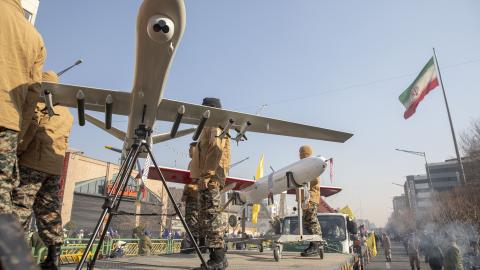





This weekend, somewhere in the mountains of southwestern Iran, the Islamic Revolutionary Guard Corps (IRGC) was hunting an American. They were chasing the most intoxicating image: a soldier of the “Great Satan,” bloodied and captured, paraded before the cameras on the very soil his country had come to destroy, the living fulfillment of every chant of vengeance that had echoed through Iranian streets since 1979. The IRGC held all the advantages a force could ask for: home terrain, local informant networks, and within its grasp the single most valuable propaganda asset of the entire war—a prisoner whose image alone could have rewritten the narrative of a campaign that has been catastrophic for the Islamic Republic from the first strike.
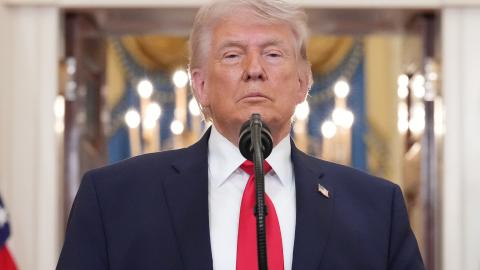
But American special operations forces got there first. And when Donald Trump announced the rescue on Truth Social in three words—“WE GOT HIM!”—the IRGC walked away with nothing but the abandoned underwear of a man they never caught.
The episode revealed three things: complete American military superiority over the Islamic Republic on its own soil; the catastrophic failure of a surveillance architecture that Beijing had spent years and billions of dollars constructing; and the increasingly inescapable conclusion that the IRGC’s viability as a military institution is approaching its terminal phase.
And something else, too: the degree to which Iranian aggression had been functioning as the principal obstacle to the Middle East’s regional order. A senior Emirati military official has confirmed that the United Arab Emirates has not ruled out joining the U.S. directly in the war against Iran. Bahrain, Kuwait, and Saudi Arabia are more committed to the campaign than at any point since it began. Qatar has broken entirely from any residual sympathy toward the IRGC.
Operation Epic Fury has made visible what Iranian pressure had long suppressed: that the Abraham Accords were not a diplomatic anomaly. Rather, they were the architectural expression of a regional consensus that Iran’s model of power projection, energy coercion, and ideological subversion had been systematically depriving the Middle East of the economic integration and security cooperation that its geography and resources would otherwise permit. The war has not created that consensus. It has confirmed it.
The IRGC entered this campaign with a strategic playbook refined across four decades of asymmetric confrontation, and it is losing on every front simultaneously. Seven strategic mistakes, each rooted in a fundamental misreading of American behavior, regional politics, and its own capabilities, have compounded into a situation with no coherent exit.
The first strategic mistake was the Strait of Hormuz. Iran’s logic was that sustained pressure on global energy flows would ignite the markets and force Trump to recalculate, withdraw, or watch the Gulf States turn against American operations out of economic self-preservation. But Trump has publicly declared that opening the strait is “not for us,” instead calling on European allies who rely on the strait to “go get your own oil.” His threat on Sunday to bomb Iranian power plants and bridges made it even more clear that the Strait’s closure will not cause an American retreat.
These declarations carry a meaning beyond the immediate military context. Trump is running two operations simultaneously: one against the IRGC, and one against the assumption that the United States will indefinitely underwrite regional security at its own expense. His threats to leave NATO, vow to send the IRGC “back to the Stone Ages,” and triumphalist mid-operation address thanking Gulf partners for their support are not the improvisations of an undisciplined communicator. They are the deliberate signaling of a strategic repositioning, designed to press allies into assuming greater responsibility abroad. The operation itself is a demonstration of what American military power can accomplish when it decides to act without hesitation.
Trump is also using the Strait of Hormuz crisis to accelerate something the administration has sought from the beginning: a Middle East in which American allies assume primary responsibility for their own neighborhood, freeing Washington to concentrate its strategic attention on the Western Hemisphere. Burden-sharing was long treated as a European conversation about defense spending. The Strait of Hormuz has just expanded the terms of that project to the entire Eastern Hemisphere by including Gulf countries as well.
The Hormuz gambit has also alienated Beijing, which is losing patience with Iran’s active disruptions to Chinese energy supply lines. The purpose of any military operation is to improve your own posture or degrade the enemy’s calculus in your favor. The IRGC achieved neither, and in the attempt accelerated its own isolation on every front simultaneously.
The second strategic mistake was time. The IRGC likely assumed that Trump’s stated desire for speed signaled an appetite for a fast exit, and that the organization could survive by dragging out negotiations, delaying any serious accommodation, and outlasting American political resolve through attrition. But time cannot be purchased in a war where American strikes are hitting command and control infrastructure at its foundations and front line units are receiving no meaningful replenishment. The IRGC has made a career of mistaking American restraint for American weakness, and the cost of that error is now being denominated in destroyed batteries, dead commanders, and a command architecture that grows less coherent with each successive wave of strikes.
The third strategic mistake was tempo. In nearly every crisis in the past two decades, the IRGC’s strategy has been to control the pace of escalation with its adversaries, calibrate pressure, and determine when and how confrontations would intensify or recede. But that model depends on a predictable opponent. Trump has demolished that predictability, and the range of American military options—from additional carrier groups and Marine landing forces to airborne troops and an ever-expanding list of targets—have multiplied more quickly than the IRGC can adapt. As Secretary of Defense Pete Hegseth said last week: “Our adversary right now thinks there are 15 different ways we could come at them with boots on the ground. And guess what? There are.” The IRGC now finds itself reactive, off balance, and unable to dictate the terms of the next exchange.
The fourth strategic mistake was overestimating its capacity to reinvigorate the Arab world against a joint American and Israeli operation. The IRGC’s regional theory of legitimacy rested on the proposition that Arab populations in the Middle East could be mobilized against American and Israeli military action in ways that would constrain Gulf rulers and force them to distance themselves from Washington. But the Abraham Accords architecture has proven more durable than Tehran anticipated, and the Arab street has failed to materialize as a meaningful strategic variable in any theater that mattered.
The fifth strategic mistake was information warfare. We’ve seen this play out before. After October 7, Hamas and Hezbollah seeded social media with fabricated footage, manufacturing narratives of resistance among Western audiences. But the illusion of battlefield success became an internal liability, feeding a leadership culture in which accurate damage assessments were suppressed in favor of narratives that preserved morale at the expense of strategic clarity. The IRGC is repeating the pattern, trying to win the battle of public opinion even as it loses the one on the ground.
The stakes are considerably higher this time, because the propaganda apparatus is operating against a backdrop of acute domestic crisis: runaway inflation, capital flight, water scarcity, and an economy in structural collapse. An organization that cannot accurately assess its own battlefield losses is even less equipped to reckon with the degree to which the Iranian population it claims to protect has already stopped believing in the institution meant to govern them.
The sixth strategic mistake was the assumption that China would serve as a meaningful backstop when the pressure became acute. Intelligence reporting indicates that Beijing has continued to provide data support to the IRGC, and Chinese technology remains embedded in what survives of Iran’s surveillance architecture. But this cannot compensate for the IRGC’s structural deterioration, and China appears unwilling to escalate its material support to a level that invites direct American economic retaliation. Thus, the IRGC is accumulating losses faster than any external partner is willing or able to replace them.
The seventh strategic mistake, and the one most structurally irreversible, was Iran’s decades-long strategy to build its offensive and defensive architecture almost entirely around a proxy network that the U.S.-Israeli campaign has systematically dismantled. Hezbollah entered the current war already severely diminished from its 2024 confrontation with Israel, its leadership decimated and its southern Lebanon infrastructure severely damaged. The Syrian buffer that Iran spent years and billions of dollars constructing has collapsed entirely, and American and Israeli forces have degraded the Houthi operation in Yemen past the point of meaningful military utility.
The IRGC was designed to project power through others rather than absorb direct confrontation itself. But the U.S.-Israeli campaign has forced upon it precisely the direct confrontation its entire architecture was constructed to avoid, leaving the organization exposed, stripped of the layered proxy depth that previously allowed it to absorb punishment at a distance, and facing an adversary that has correctly identified this exposure as the central vulnerability of the entire Iranian strategic posture.
What stands before Trump today is an IRGC stripped of its mystique, its command structure gutted, its proxies dismantled, and its vulnerabilities laid bare on its own soil in ways that decades of institutional construction were designed to prevent.
Trump and Benjamin Netanyahu have already addressed the Iranian people directly, instructing them to stay home and stay clear of further attacks. The regime responded by shutting down the internet, a measure that speaks less to operational security than to the elemental fear of a government that cannot afford for its own population to watch what is happening.
There is no third option, no face-saving arrangement, no regional patron positioned to alter the terms. The choice for Iran is either compliance or collapse, and the distance between those two destinations is shorter than Tehran has ever been willing to admit.